
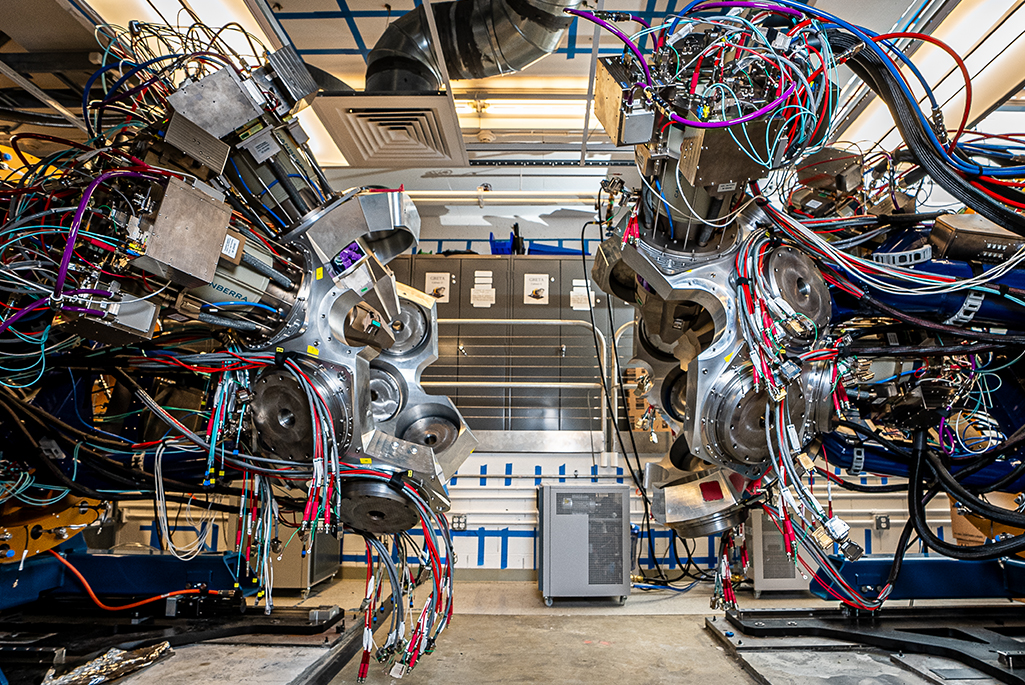
After years of intensive design, building, and testing, GRETA, the Gamma-Ray Energy Tracking Array, is on track to be completed at Berkeley Lab this summer. The instrument passed a successful Director’s review at Berkeley Lab in April, having met all performance goals through testing at the system and individual component levels. A special workshop and dedication ceremony at the end of April marked the close of decades-long planning and implementation, an effort that relied on collaborations across Berkeley Lab’s Engineering Division, Nuclear Science Division, ESnet, Science IT, and outside institutions to bring this new instrument to life.
This summer, GRETA will be carefully packaged up and delivered to the Facility for Rare Isotope Beams (FRIB) at Michigan State University. There, GRETA will measure the energy and reveal the 3D position of gamma rays hitting the detectors in real time with unprecedented resolution, helping physicists study the structure of atomic nuclei. In fact, when GRETA comes online, it will be the world’s most sensitive gamma-ray spectrometer, making it a powerful tool for exploring the fundamental building blocks of the universe. Scientists hope that GRETA will help them discover new isotopes, understand how atomic nuclei behave under extreme conditions, and reveal how elements form in stars, among other things.
The culmination of this stage of the GRETA project represents the efforts of a monumental collaboration between stakeholders within Berkeley Lab to get the project over the line.
“It makes life so much easier when everyone is working together,” says Eric Buice, GRETA Project Engineer at Berkeley Lab. “That is what has made this one of the best projects I’ve been involved in during my career. Everyone here supports each other to achieve the greater goal. You can’t do a project like this alone. It takes everyone – engineers, scientists, technicians – working in partnership.”
Engineering brings GRETA to life
Berkeley Lab Engineering has a long history of designing and building large-scale detector arrays, with deep experience and institutional knowledge of the electronics and mechanical design of these instruments. GRETA itself has been designed to expand the capabilities provided by its predecessor instrument, the Gamma-Ray Energy Tracking In-beam Nuclear Array (GRETINA), an instrument that was also designed and built by engineers and scientists at the Lab.
GRETA provides a leap forward in gamma-ray spectroscopy. Whereas GRETINA has 48 high-purity germanium crystal detectors arranged in 12 quad modules covering about one-quarter of a full sphere, GRETA has an expanded array of detectors providing full solid-angle coverage by hosting 120 crystals arranged in 30 quad detector modules. As a consequence, GRETA is designed for higher data acquisition rates, with each of the 120 crystals running at up to 50,000 signals per second and the array writing >500,000 events per second to disk. The result is a much more sensitive instrument, capable of providing greater granularity, higher resolution, better tracking precision, and more data.

An up-close look at several of GRETA’s germanium detectors, each made up of four position-sensitive quadrants, installed for testing at Berkeley Lab. (Credit: Marilyn Sargent, Berkeley Lab)
“GRETA will be a world-leading instrument, offering unprecedented sensitivity and providing the ability to detect and reject background events,” explains Heather Crawford, a Senior Staff Scientist in the Nuclear Science Division and Deputy Project Director of GRETA. “We’re going to be able to observe more and more exotic nuclei. It’s going to have a huge impact.”
A new instrument, new capabilities, and new science all come with technical challenges that must be addressed with rigorous application of engineering principles throughout the design and construction of the instrument. Engineering has been instrumental in every step of the process, from design and manufacturing to testing, survey, and alignment. Further, the Engineering Division has supported not only the detector but also all of the infrastructure associated with the detector, including electronics, cooling, and computing systems.
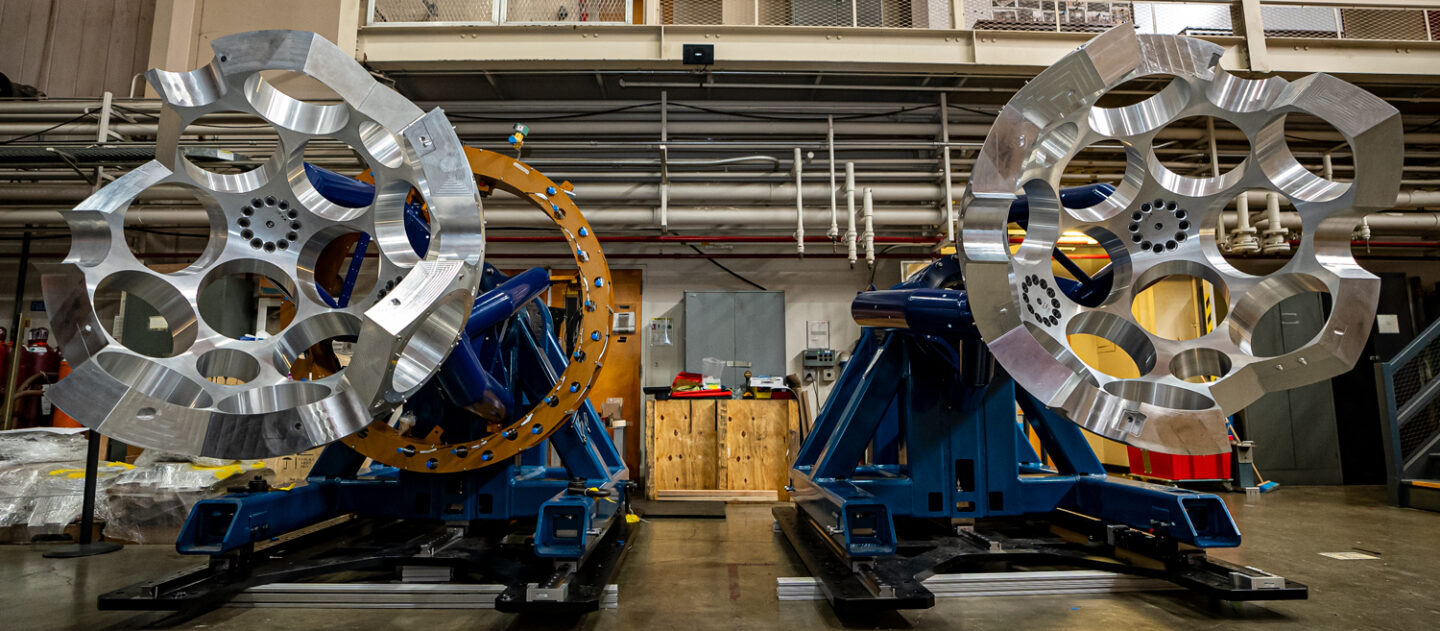
A key component of the instrument is the precision-machined aluminum hemisphere that supports and aligns the detector modules. Aluminum was selected because it is a strong, lightweight material with low-Z to reduce gamma-ray scattering, it has high thermal conductivity, and it is easy to machine – properties that aid in maintaining structural integrity and facilitating thermal management.
Each section of the frame started as a solid block of aluminum and was carefully machined into a curved segment of a sphere. Three segments were joined together to form each hemisphere of the frame. The two hemispheres are mounted to a welded support frame that allows them to slide together smoothly, fully enclosing the reaction target during operation.
Each of GRETA’s 30 detectors has its own individual housing within the aluminum frame. This is part of an intentional design. It allows the detectors to be added, tested, and replaced independently, without causing disruption to the entire system. Each detector is fragile, heavy, expensive, and time-consuming to build, so must be treated with extreme care when it is loaded into GRETA. That’s why GRETA’s sphere was designed so it can be rotated, allowing each detector to be loaded into the instrument on a horizontal plane.
When GRETA arrives at its intended destination at FRIB, it will need to move within the facility to accommodate different experiments. Moving GRETA is not a trivial task, however. Each side of the instrument weighs about 4 metric tons without the detectors installed. With this in mind, the entire structure of the instrument, minus the detectors, can be moved as one unit. The design of GRETA minimizes the amount of effort it takes to move.
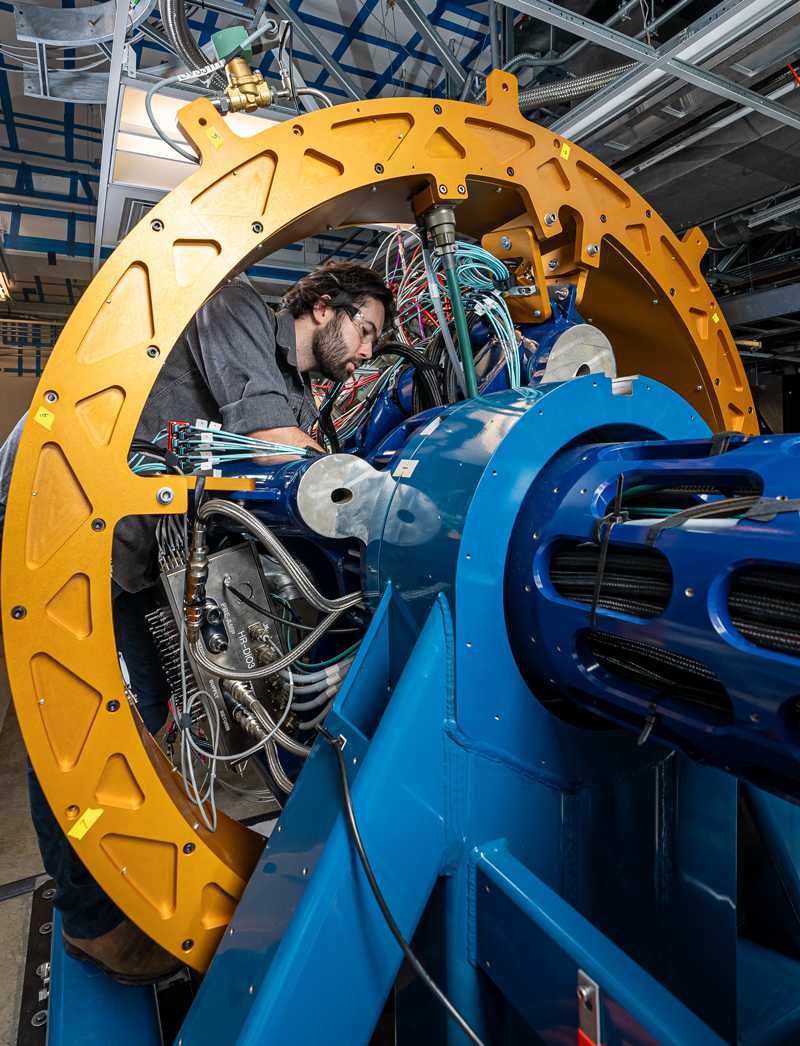
Caption: Mechanical Engineering Technician Nathan Seidman examines connections on the assembly for GRETA. The yellow ring is part of the cryogenic cooling system. Credit: Marilyn Sargent, Berkeley Lab
Another challenge of the project is that, in order to function properly and provide accurate data, GRETA’s high-purity germanium crystal detectors must be kept at extremely cold temperatures of around 80 Kelvin (-315.67 Fahrenheit), meaning they must be cryogenically cooled. This serves the function of reducing thermal noise for the detectors – at room temperature, the signal from the detectors is overwhelmed.
To meet this challenge, Berkeley Lab Engineers custom-designed, assembled, and tested vacuum cryostats and liquid nitrogen manifolds to deliver cryogenic temperatures with minimal thermal stress on surrounding materials.
Another feature that will contribute to the operational use and maintenance of GRETA is the project documentation that will be tied to the instrument throughout its lifetime.
“One of the biggest advancements we’ve made is how we’ve documented everything in Windchill,” explains Buice. “When we hand GRETA over, we will also provide data that will assist in the operation and management of the instrument for its planned life of about 30 years.”
This includes drawings, schematics, and design information that will help operators maintain and repair GRETA many years down the line.
Electronics custom-made for GRETA
Engineering contributions to GRETA extend beyond the design and fabrication of the array to many of the electronic systems that support the detector. Berkeley Lab electronics engineers are responsible for GRETA’s digitizer and detector interface box, as well as the rack-mounted components providing power, signal processing, and data acquisition hardware.
GRETA’s digitizers are boxes that attach to the individual detectors and convert the analog signals from the germanium crystals into a digital data stream. The boxes were custom-designed by engineers at the Lab using off-the-shelf electronic components. There are 120 digitizer boxes on GRETA, one for each crystal.
Recent advances in technology allowed for an innovative design choice – keeping the digitizers as close as possible to the detectors. This choice allowed for several improvements to be made all at once. Analog systems have a certain amount of degradation, so when the digitizer is closer to the detector, the cabling is automatically shortened, helping to mitigate this issue. Additionally, shorter cables help reduce the cabling complexity associated with the system.
“We tried to keep the function of the digitizer box simple, and keep its function limited to the basic data acquisition side,” explains Thorsten Stezelberger, Lead Electronics Engineer for GRETA and part of the larger team working on the electronics for the project. “The goal was that once the digitizer is working, we don’t have to touch it. All the things needed to extract data are downstream in the rack.”
That leads to another benefit of this novel design. As computing technology and components like Field-Programmable Gate Arrays (FPGAs) improve in the coming years, these parts of the system can be upgraded without interfering with GRETA’s more delicate analog components.
Another notable design aspect of the digitizer box is that it employs conductive cooling, which transfers heat from a warmer object to a cooler object, to keep the components cool. The initial plan was to use a fan system within the box; however, the system must be able to operate next to powerful magnets. During the testing process, it was discovered that the magnetic fields eventually caused the fans in the digitizer to fail. As a result, the fan cooling system was replaced with a conductive cooling system. The tradeoff for this decision was that it added extra complexity and weight to the digitizer boxes, which was mitigated by a new support design, developed through a collaboration between the mechanical and electronics engineering teams.
“When the array is fully set up and all of the detectors are fully installed, the space is really tight,” says Stezelberger. “That’s where we really had to work with mechanical engineering to say, how can we make this so it fits in? That was a really nice collaboration between engineering disciplines to get these boxes designed so everything fits. That’s the benefit of having a close working relationship.”
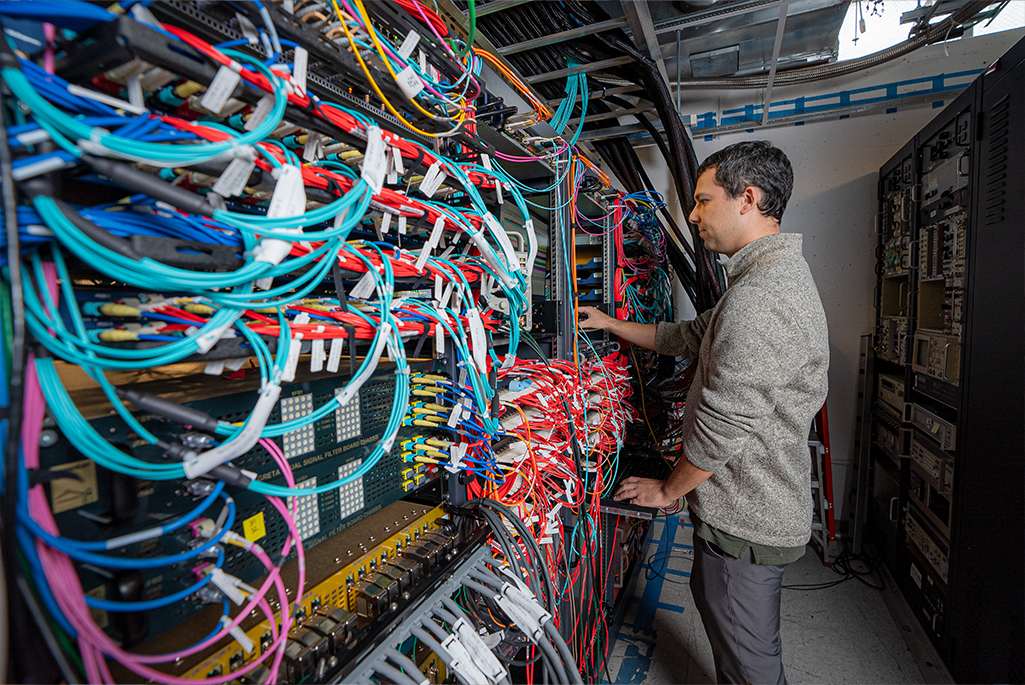
Engineering Division Software Developer Tynan Ford adjusts GRETA’s electronics rack, which includes a combination of commercial and custom-made components. Credit: Marilyn Sargent, Berkeley Lab
The rack that supports GRETA contains a mixture of off-the-shelf and custom components. Custom fiber optic cables bring the data from the GRETA digitizers to the racks for signal processing. Processing takes place via custom fiber interface boards and commercial FPGA boards sitting in the racks. The racks also house power supply systems and cable breakouts.
Rigorous review and analysis have gone into ensuring all of these systems work in harmony.
“Testing, testing, testing!” Stezelberger advises. “So many of the little issues you find only when you test something. And testing with the real system is crucial because on the bench, everything looks too good.”
Engineering to the finish line
Engineering work on GRETA didn’t stop once the system had been built. When the instrument was set up for final evaluation, the team realized that the crane needed to lift the detectors into place was too tall for the room.
“Looking at it, we needed the floor to be lower, the ceiling to be higher, or the crane to be shorter,” Crawford recounts. “The easiest solution was to make the crane shorter.”
The Engineering Division Machine Shop was able to remove a middle segment of the crane and weld it back together for inspection and use within two days of the problem being identified, ensuring no impact to the delivery schedule.
Berkeley Lab is currently wrapping up final testing of the instrument and working on custom-designed structures for shipping the instrument that will minimize movement during transport.
“It’s exciting to send GRETA off into the world,” Buice says. “Engineering has made a huge contribution to this instrument, and now we’re looking forward to seeing the many scientific discoveries that it will play a part in.”
