
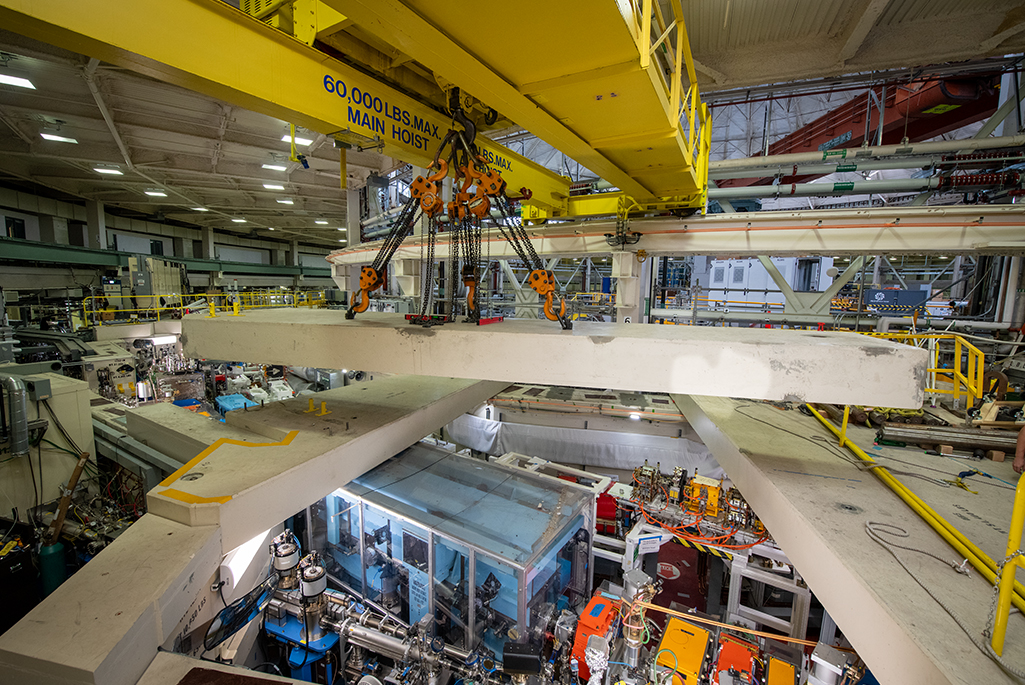
During the 12-week summer shutdown of the Advanced Light Source (ALS), engineers, mechanical technicians, and riggers will perform a phased removal of 18 concrete roof blocks on the facility’s storage ring tunnel – the outer ring of the accelerator where X-ray radiation is generated for beamlines. The storage ring is encased in a concrete structure that provides radiation shielding, with 12- to 18-inch-thick roof blocks making up the top of the structure. A large bridge crane known as the “annex crane” spans the circumference of the tunnel and is used for both moving roof blocks and removing or installing accelerator equipment. The relocation of roof blocks is crucial to enable crane access within the tunnel and facilitate the installation of sensitive equipment in tight spaces.
The effort taking place during this summer shutdown represents the greatest number of roof blocks removed during any ALS shutdown to date. This makes it an excellent dry run for the many roof block moves necessary during the ALS facility’s Dark Time. Scheduled to take place in the near future, Dark Time is the critical period of downtime when the present-day ALS storage ring will be removed and a new ring built and commissioned in its place.
“Out of the 18 roof blocks being removed during this shutdown, the largest one weighs just over 52,000 lbs. It is about 25 feet long, 9.5 feet wide, and 18 inches thick,” says Adam Stewart, a mechanical engineer in the Manufacturing Engineering Department at Berkeley Lab. “Each roof block move takes around two hours to complete. Our experienced team of riggers and mech techs can typically complete up to four roof block moves in a single day.”
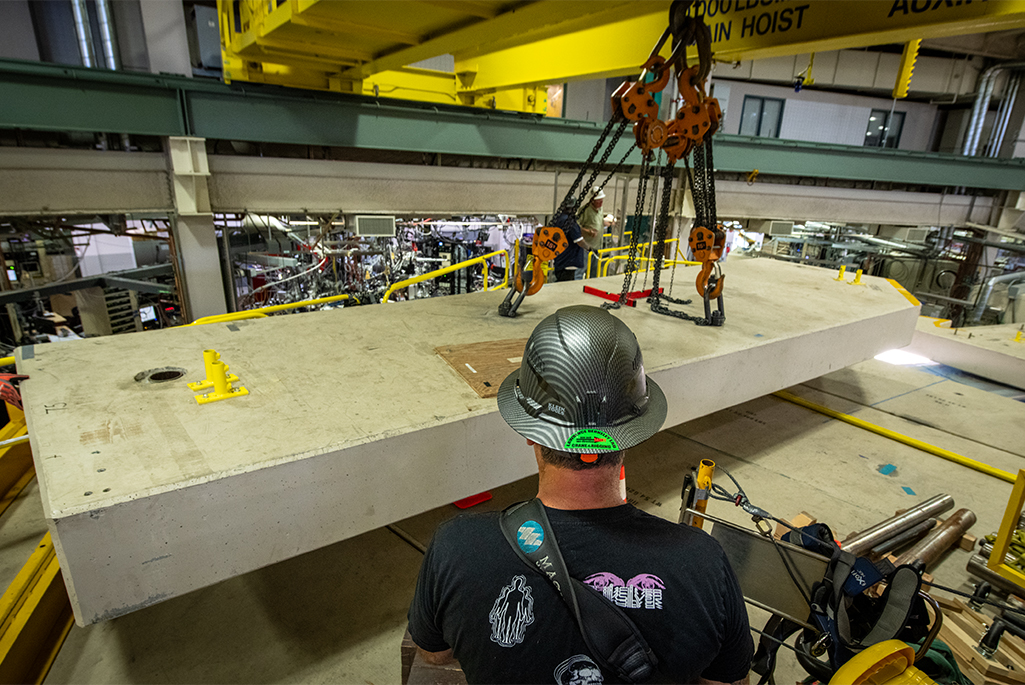
The roof block removal will facilitate work on the new accumulator ring and the booster-to-accumulator (BTA) transfer line installation in Sector 12. The ALS storage ring is divided into 12 Sectors, and Sector 12 is particularly challenging due to its tight space constraints and the presence of two storage rings and two beam transfer lines that feed the existing storage ring and the new accumulator ring from the booster synchrotron ring in the ALS. Roof block removal provides the necessary crane access to install accelerator components and equipment that make up the accumulator ring and BTA. Additional roof blocks will be removed in Sectors 1, 7, and 11 to allow critical seismic retrofit work and other ALS maintenance projects to be carried out.
Storage of the temporarily displaced roof blocks is a large part of the logistical challenge of this work. The blocks are typically stacked elsewhere on the tunnel during storage, but strict structural and seismic protocols must be followed. Engineers must ensure that the stacked blocks do not exceed the allowable temporary loading capacity of the tunnel walls and the concrete foundation slab. Compliance with seismic codes is important for the accelerator that is housed within the historic ALS building, which was constructed in the early 1990s and surrounds the original 1930s-era dome designed by Arthur Brown Jr., the architect of Coit Tower in San Francisco.
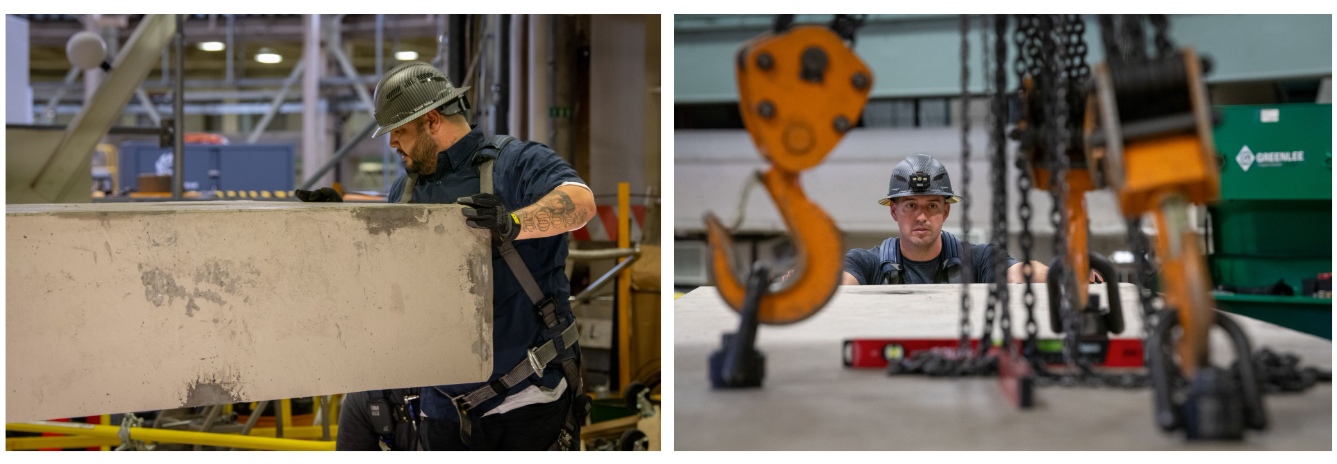
During storage, roof blocks are stacked on wooden pieces of cribbing in order to protect the concrete and help distribute their weight. In some cases, two roof blocks will be “double stacked,” one on top of the other. The cribbing must be deliberately configured to comply with seismic requirements, which is particularly important for double-stacked blocks. Additionally, due to the different shape and size of every roof block, each temporary storage area in the tunnel is chosen ahead of time and then validated in the building CAD model to ensure that there is room for the roof block and space for personnel access.
“When roof blocks are stacked on the tunnel, they may block off pathways for other roof block moves,” explains Stewart. “In some cases, scaffolding on the tunnel roof will also restrict crane access through the area, preventing roof block movement. All of this must be considered when putting together the full sequence of roof block moves and laydown areas. It is like a game of 3D Tetris with massive concrete blocks.”
Safety is an important part of this work, given the enormous weight and height involved in each crane lift and the potential risk to the facility. The facility rigging and the ALS/ALS-U technician teams have developed a full rigging plan that involves integrated safety management and includes processes from start to finish. A cross-functional team of 8-10 people observes each move, provides rigging expertise, crane operation, lift management, fall protection monitoring, and tunnel safety monitoring. Additionally, the Lab has a “roof block library,” an archive of rigging plans for each of the 82 roof blocks that can be referenced and reused when blocks are moved.
