
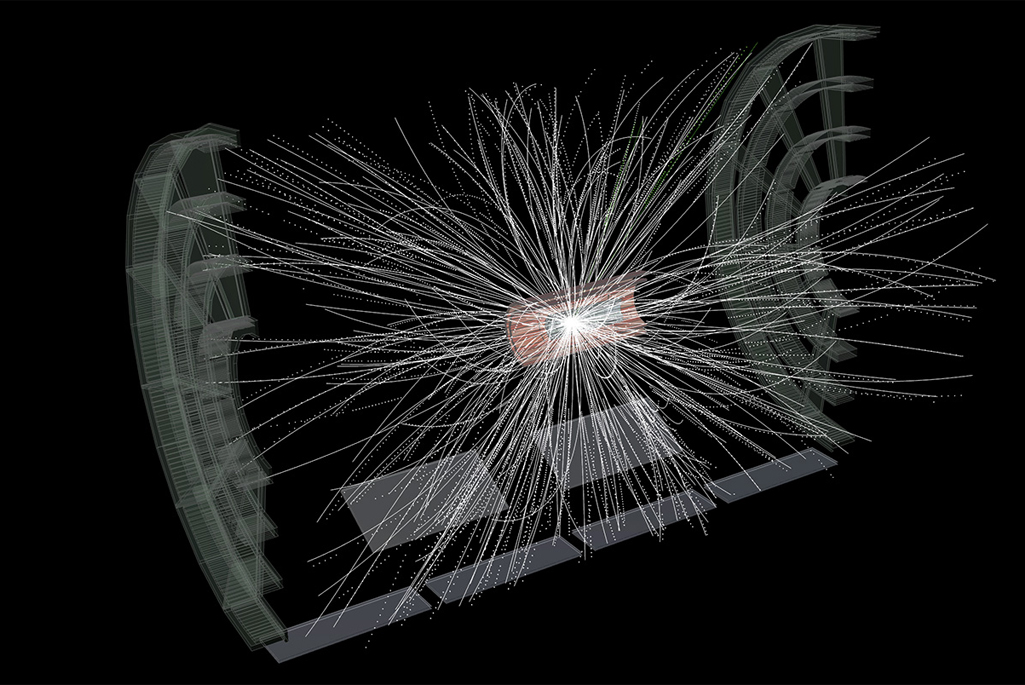
Barbara Jacak, a nuclear physicist in Berkeley Lab’s Nuclear Science Division, is quoted in this new article in Science Magazine about the Relativistic Heavy Ion Collider (RHIC) at Brookhaven National Laboratory.
After two decades of groundbreaking research, the RHIC is at the end of its mission. Known as the world’s only dedicated atom smasher for recreating the primordial matter of the early universe, the RHIC successfully produced and studied the exotic quark-gluon plasma (QGP). Its legacy is marked by significant discoveries, including the unexpected finding that this fiery soup of quarks and gluons behaves more like a perfect liquid than a gas. This remarkable achievement provided the first “irrefutable proof” that the conditions of the Big Bang could be replicated in a laboratory, cementing RHIC’s place in the history of nuclear physics.
While the study of QGP now transitions to the Large Hadron Collider at CERN, RHIC’s facilities will undergo a major transformation to become the new Electron-Ion Collider (EIC), a next-generation machine that will probe the internal structure of protons and nuclei, building on the knowledge gained at RHIC.
Berkeley Lab’s Relativistic Nuclear Collisions (RNC) Program has played a crucial role throughout the RHIC’s history, making significant contributions to the STAR and sPHENIX experiments that were essential for these discoveries. Their work in developing detectors and analysis techniques was pivotal in unraveling the mysteries of the QGP, and the group is now taking on similar roles in developing the detectors and the physics program for the future ePIC experiment at the EIC.
