Physical Sciences logo
  • About
    • Leadership
    • Organization
    • Strategic Plan
    • Contact
  • Research
    • Experiments & Projects
    • Capabilities
  • News
  • Careers
  • PSA Internal
    • Area Communications
    • Discretionary Funding
    • Event Guidance
    • Infrastructure Investments
    • LDRD Program
    • Mentoring Program
    • Morale Funds
    • Parking Permits
    • Stewardship Council
  • About
    • Leadership
    • Organization
    • Strategic Plan
    • Contact
  • Research
    • Experiments & Projects
    • Capabilities
  • News
  • Careers
  • PSA Internal
    • Area Communications
    • Discretionary Funding
    • Event Guidance
    • Infrastructure Investments
    • LDRD Program
    • Mentoring Program
    • Morale Funds
    • Parking Permits
    • Stewardship Council
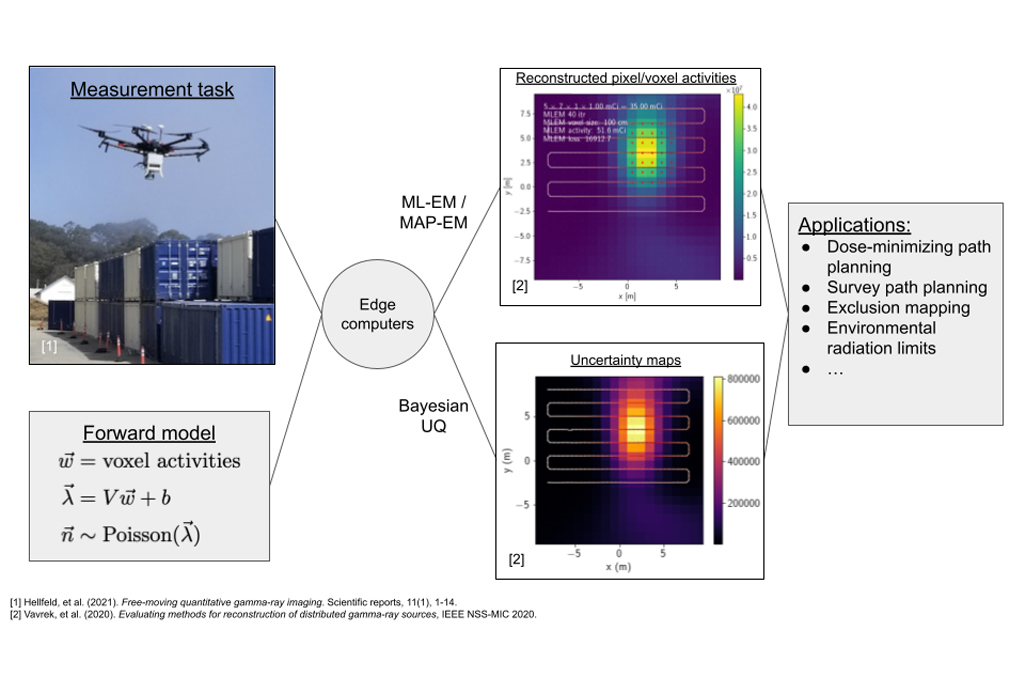
Illustration of the radiological mapping and image reconstruction process, which plays a critical role in many nuclear security related applications. A detector system carried by an unmanned aerial vehicle scans the field to measure the counts due to environmental background and potential radioactive sources. The data collected during the mapping is processed on an edge computer. With traditional methods, such as MLEM, the major results output from the computer is a map showing the estimated radioactivity intensity. Using Bayesian methods, the major results output includes not only a radioactivity intensity estimate, but also their associated uncertainties. (Credit: Jayson R. Vavrek)

Fast Machine Learning-Enabled Uncertainty Quantification for Radiological Mapping

  • Article
  • Nuclear Science
Tags:
  • Nuclear Science

Links

  • About Us
  • Research
  • News
  • Work with Us

Contact Us

  • Contact

Connect

Our Organization

  • Lawrence Berkeley National Laboratory
    • Physical Sciences Area