
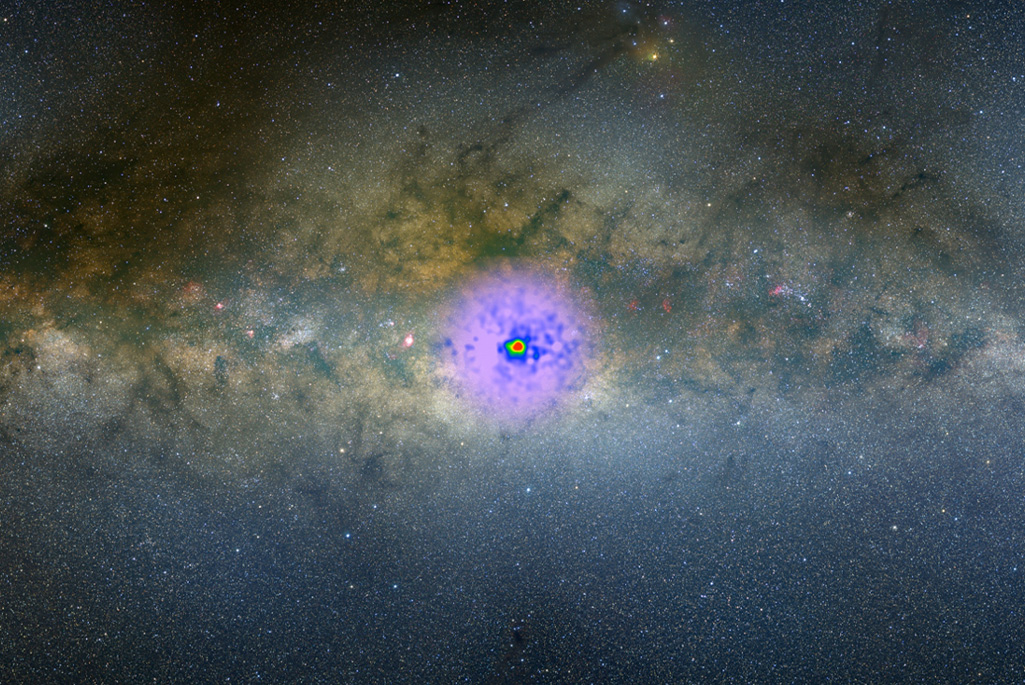
A faint, spherical glow of gamma rays emanating from the center of our galaxy – dubbed the Galactic Center Excess – has tantalized physicists for over a decade as a potential signal of dark-matter annihilation. But competing explanations, most notably a vast population of rapidly spinning neutron stars called millisecond pulsars, have kept the question open. A key piece of evidence favoring the pulsar interpretation came from analyses showing the excess appeared to be composed of dim, discrete point sources rather than the smooth glow expected from dark matter.
Those earlier analyses, however, discarded a crucial piece of information: the energy of each detected photon. In a new study published recently in PRL, a team at Berkeley Lab and the University of Vienna developed a machine-learning framework trained on over a million simulated sky maps to analyze both the spatial distribution and the energy spectrum of the gamma-ray data simultaneously for the first time. The addition of energy information dramatically changes the picture: the inferred point sources become so faint that the signal becomes statistically indistinguishable from the smooth glow dark matter would produce. If the excess is instead due to point sources, there would need to be at least 35,000 of them, far more than previously claimed. The possibility that the Galactic Center Excess originates from dark matter remains very much alive.
“Interpreting the signal is particularly difficult because the Galactic Center is an exceptionally bright and crowded region of the gamma-ray sky,” explains Florian List, study author and researcher at the University of Vienna. “Our work does not show that dark matter is responsible for the signal. However, it suggests that it is still too early to rule out this possibility.”
“The galactic center excess has been a huge puzzle for almost twenty years,” explains Nick Rodd, another study author and divisional fellow in Berkeley Lab’s Physics Division Theory Group. “But with AI and machine learning we’re finally breaking through old obstacles to understanding the problem, and while many questions remain, the case that the excess originates from dark matter looks as compelling as ever.”
Learn More: Dark Matter in the Center of the Milky Way Not Ruled Out
June 17, 2026 / University of Vienna News
