
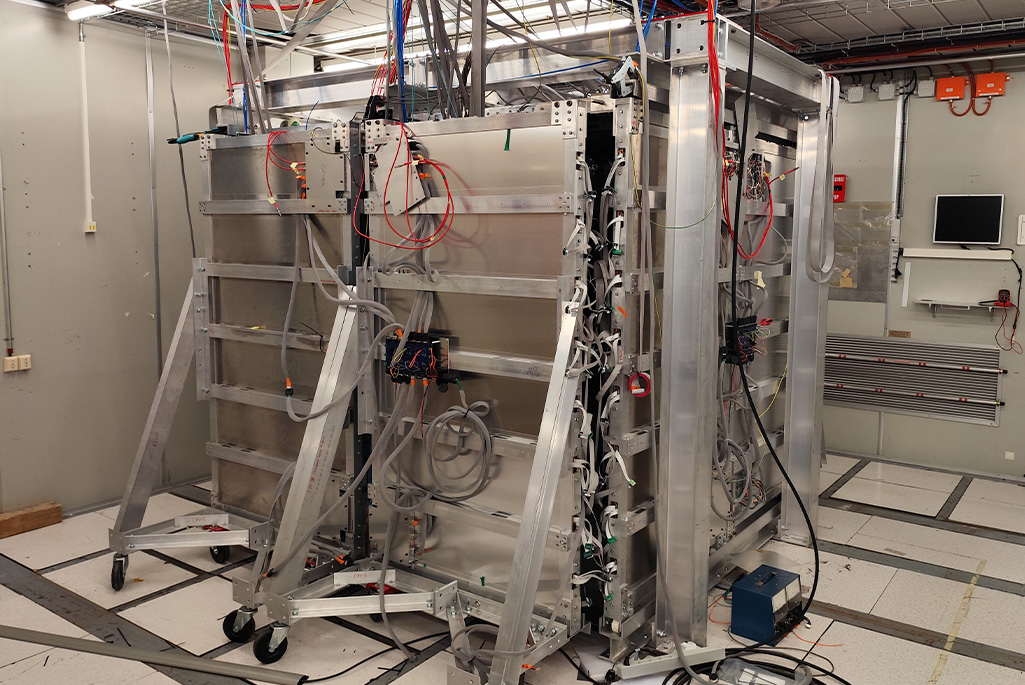
In a milestone achievement, the CODEX-b (COmpact Detector for EXotics at LHCb) collaboration has recorded its first data with the ‘CODEX-β’ (or CODEX-beta) prototype detector at the Large Hadron Collider, starting in May 2026, marking a critical step in demonstrating the search power of a new class of particle detectors.
CODEX-b is a proposed specialized detector for the Large Hadron Collider at CERN, the European Organization for Nuclear Research. Developed by a small international collaboration of scientists, CODEX-b is designed to search for elusive signals of ‘hidden sectors’ in nature: particles and fields that exist beyond the known Standard Model. These hidden sectors may hold solutions to several profound mysteries, such as the makeup of dark matter, the origin of the universe’s matter-antimatter asymmetry, and the naturalness of the electroweak vacuum. But many types of hidden sectors can be very hard for the main LHC detectors – ATLAS, CMS, LHCb, and ALICE – to easily explore.
The high-energy collisions at the LHC can instead access heavy-particle portals into these hidden realms, where lighter so-called long-lived particles may be produced and slowly decay back into visible matter. The CODEX-b experiment aims to detect such decays, often far displaced from the LHC collision point, potentially providing the first window into the physics ultimately responsible for many long-standing puzzles in modern high-energy physics.
Key to the experiment is a special ‘actively shielded zero-background’ environment that only hidden long-lived particles can populate before they decay. The CODEX-β detector is a smaller 1:5 scale prototype version of CODEX-b, approximately 2-by-2-by-2 cubic meters in size. Its main purpose is to take critical measurements needed to design the active shield for the full-sized detector and to optimize the detector concept, which is also used in several other proposed long-lived particle detectors.
“Designing and building this prototype was a tremendous effort by a small group of dedicated high-energy physicists and engineers, many of whom donated their spare time to the effort,” said Philip Ilten, a professor at the University of Cincinnati and spokesperson for the experiment. “The data from this prototype will be essential to realizing this type of detector concept, showing that we really can search for new physics this way.”
CODEX-b was proposed in 2017 by a collaboration of four scientists from Lawrence Berkeley National Laboratory (Berkeley Lab), the University of Cincinnati, and Paris LPNHE. Since then, the collaboration has grown to approximately 60 members at 20 institutions around the world.
The full-sized CODEX-b experiment, if approved by CERN, will occupy an available space adjacent to the LHCb detector within the LHC’s interaction point 8 cavern. Approximately 10-by-10-by-10 cubic meters in size and utilizing detector technology designed for ATLAS, the CODEX-b detector will be able to explore a very broad range of New Physics scenarios, ranging from axion-like particles, to heavy neutral leptons, to light scalar particles coupling to the Higgs boson.
“Even though the long-lived particles CODEX-b will search for are quite light in mass compared to the Higgs boson, being near an LHC collision point allows the experiment to explore exotic interactions with the Higgs boson itself,” said Dean Robinson, a theorist at Berkeley Lab and one of the authors of the CODEX-b physics case proposal. “Better understanding how the Higgs interacts could be at the core of many open problems in particle physics today, and passing this milestone for CODEX-β is really exciting.”
Learn more:
Could unknown particles be hiding at the LHC?
New prototype detector that will try to find out takes its first data at CERN
July 13, 2026 / DESY News
