
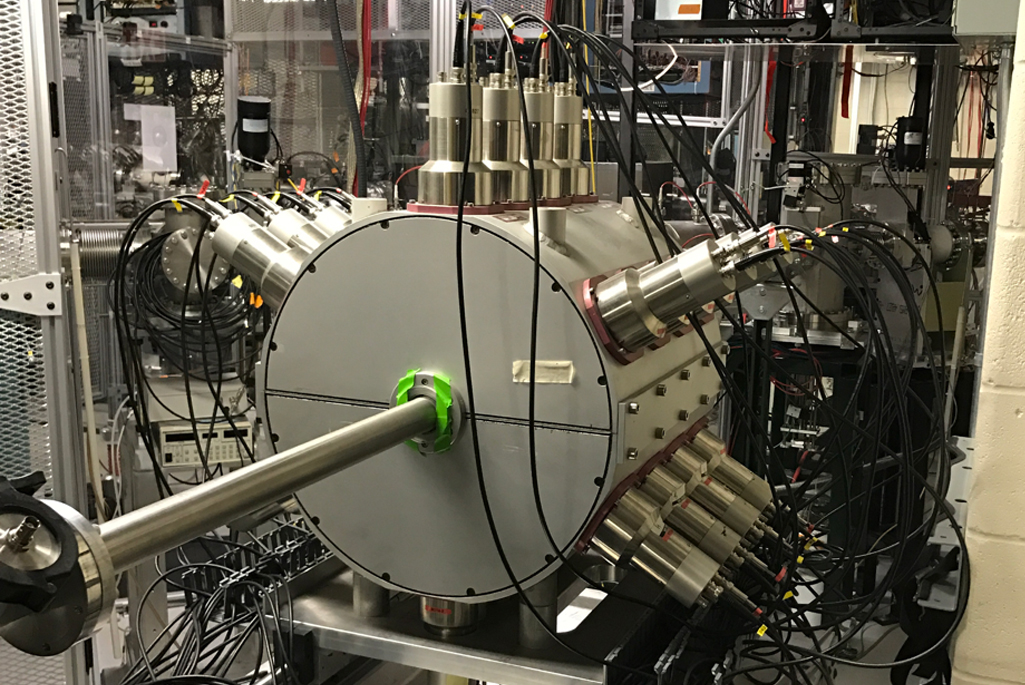
An international collaboration working at the Facility for Rare Isotope Beams (FRIB) at Michigan State University announced today that it has demonstrated for the first time that the long-debated low-energy enhancement in atomic nuclei is magnetic in origin, resolving a question that has remained open for nearly two decades. The result, published in the journal Nature, improves predictions of nuclear reactions that govern the formation of heavy elements in stars and advances our understanding of nuclear structure.
Mathis Wiedeking, a Nuclear Science Division scientist who led Berkeley Lab’s involvement in this effort, has played a leading role in the study of the low-energy enhancement since its early experimental confirmation at the 88-Inch Cyclotron. In 2012, Berkeley Lab researchers provided one of the first definitive demonstrations that the enhancement was a real physical phenomenon, motivating new theoretical and experimental studies. More recently, Mathis Wiedeking developed the model-independent Shape Method used to determine gamma-ray strength functions and contributed to the present Nature study, which establishes the magnetic character of the low-energy enhancement for the first time. LBNL continues to lead investigations using the GRETINA detector array to explore the behavior of the enhancement at the lowest gamma-ray energies and its implications for nuclear structure and nuclear astrophysics.
Learn More:
Magnetic clues inside atomic nuclei help explain how elements form in stars
July 15, 2026 / FRIB News, Michigan State University
Magnetic character of the low-energy enhancement in 70Zn
July 15, 2026 / E. K. Ronning et al / Nature
