
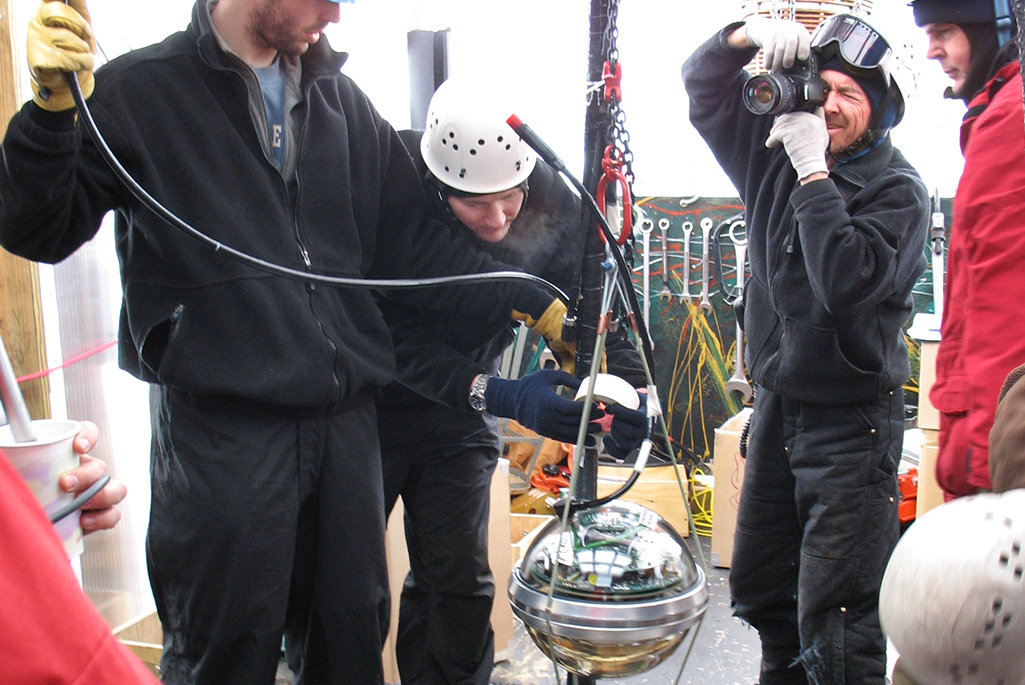
Congratulations to Francis Halzen of the University of Wisconsin–Madison, who was awarded the 2026 Nobel Prize in Physics on Oct. 6, “for decisive contributions to the IceCube Neutrino Observatory and the discovery of high-energy neutrinos of astrophysical origin.”
Berkeley Lab scientists and engineers played a significant role in the IceCube Neutrino Observatory‘s conception and construction, and they continue to play an integral role in ongoing data analysis as part of the IceCube Collaboration. Learn more about IceCube’s first decade of discovery, with contributions from Berkeley Lab’s Nuclear Science, Engineering, Physics, and computational science Divisions.
“The IceCube team has gone far beyond anything we would have dared to put in our proposal,” says Nuclear Science Division physicist Spencer Klein, who studies neutrino astronomy and neutrino interactions with IceCube. “Lots of our current analyses were things we would never have dreamed of when we were getting started.”
Learn more:
Berkeley helped make IceCube a success — and earn its leader the 2026 Nobel Prize in Physics
October 8, 2026 / Robert Sanders / UC Berkeley News
University of Wisconsin–Madison’s Francis Halzen Wins 2026 Nobel Prize in Physics for Neutrino Research – October 6, 2026 / Berkeley Lab Elements
Francis Halzen, IceCube principal investigator, wins 2026 Physics Nobel Prize – October 6, 2026 / IceCube Neutrino Observatory
Visiting Antarctica in service of science – October 14, 2025 / Allison Barker / Berkeley Lab Engineering Division News
Celebrating IceCube’s First Decade of Discovery – May 13, 2021 / rpercz / Berkeley Lab News Center
90 Years of Neutrino Science – December 4, 2020 / Glenn Roberts Jr. / Berkeley Lab News Center
IceCube Neutrinos Point to Long-Sought Cosmic Ray Accelerator – July 12, 2018 / Glenn Roberts Jr. / Berkeley Lab News Center
Into the Ice: Completing the IceCube Neutrino Observatory – December 17, 2010 Paul Preuss / Berkeley Lab News Center
