
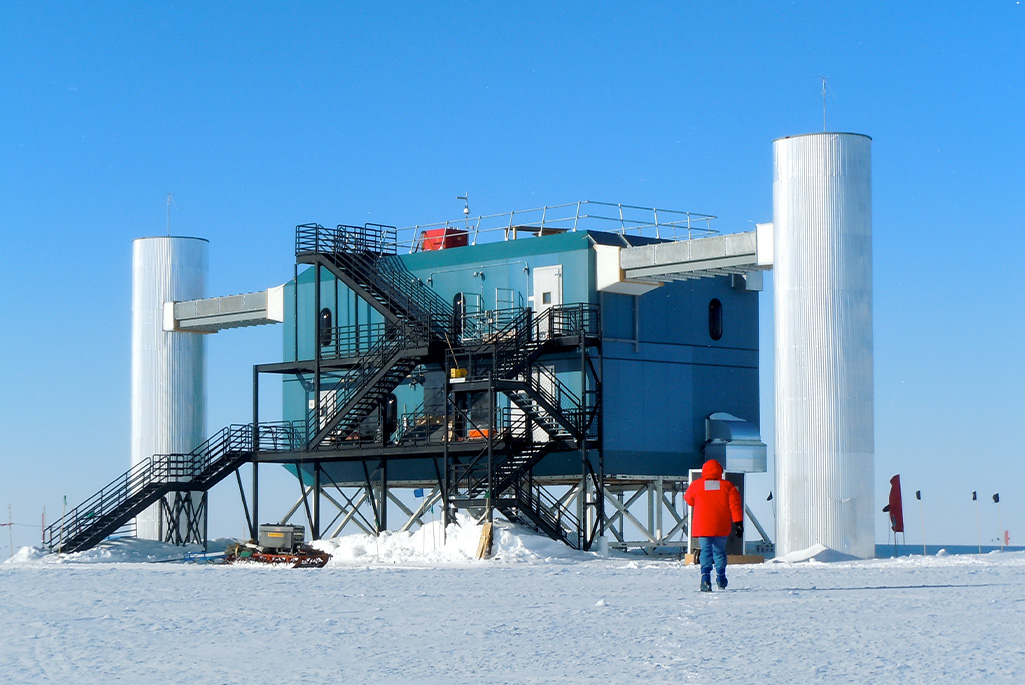
Francis Halzen’s 2026 Nobel Prize-winning work, “for decisive contributions to the IceCube Neutrino Observatory and the discovery of high-energy neutrinos of astrophysical origin,” relied on decades of planning and research by hundreds of scientists and engineers around the world, including at Berkeley Lab.
The IceCube Neutrino Observatory is designed to observe the cosmos from deep within the South Pole ice by searching for nearly massless subatomic particles called neutrinos. These high-energy astronomical messengers provide information to probe the most violent astrophysical sources: events like exploding stars, gamma-ray bursts, and cataclysmic phenomena involving black holes and neutron stars.
Approximately 450 physicists from 58 institutions in 14 countries make up the IceCube Collaboration. IceCube is operated by Halzen’s home institution, the University of Wisconsin–Madison, and is supported by the National Science Foundation.
Berkeley Lab is among the collaborating institutions; going back several decades, its scientists and engineers played a significant role in IceCube’s conception and construction and continue to play an integral role in data analysis. This 2021 article celebrating IceCube’s first decade of discovery provides an overview of the Lab’s contributions, including from NERSC and the Nuclear Science, Engineering, and Physics Divisions.
Watch Berkeley Lab’s News Center for more about the Lab’s contributions to the 2026 Nobel Prize in Physics.
