In 2009, Berkeley Lab Engineering Division Electronics Engineer Thorsten Stezelberger and Nuclear Science Division Senior Scientist Spencer Klein went on a rather unusual business trip. They weren’t at a budget hotel in a mid-size American city, not at a conference, or presenting findings to colleagues. They were camping, 9,000 miles away from Berkeley Lab on the Ross Ice Shelf, a sheet of glacial ice about the size of France that abuts the southern side of Antarctica near the Ross Sea. They were working on ARIANNA, a proposed neutrino detector that, if deployed, would be built in Antarctica. The project was seen as a potential follow-on to IceCube, another Arctic neutrino observatory. However, before ARIANNA could move forward, the hardware had to be tested in the field.
The idea behind ARIANNA was to observe radio wavelengths emitted by neutrinos using antennas buried deep in the Antarctic snow. The Ross Ice Shelf was an excellent location for the project: the water below the ice would act as a mirror, reflecting the radio signals generated by the neutrino events back at the antennas located in the ice above.
“Camping on the Ross Ice Shelf was not the original plan,” says Stezelberger. “We were working on the radio antenna. It just worked out with ARIANNA that we had a chance to go there and actually test it in the field instead of somebody else taking it and trying it there. It is always a benefit to be able to test something in the field.”
Stezelberger and Klein were both veterans of IceCube, meaning they had experience working in Antarctica. In fact, Stezelberger had already been to Antarctica four times in service of IceCube, and had spent two seasons at the South Pole, helping to drill holes for the sensors that form the IceCube detector.
While previous experience in Antarctica was helpful as Stezelberger and Klein prepared for their ARIANNA expedition, the difference between the two projects was stark, both in terms of the environment and working conditions. For IceCube, both Stezelberger and Klein were located at the South Pole, where there is a polar station with a relative degree of comfort and amenities. With ARIANNA, the two would be camping for nine days on the ice in a remote location about a 45-minute helicopter ride from McMurdo Station, the US Antarctic research base on the tip of Ross Island.
“The two sites are very different, climate-wise,” remarks Klein. “The ARIANNA site was typically around freezing. In fact, we had issues with it being too warm. If you walked around, the pressure would cause some of the top snow to melt. Ice is very transparent to radio waves, water is not. So that was an issue. But, climate-wise, it was really pretty comfortable.”

An icebreaker at McMurdo Station, Antarctica. (Credit: Spencer Klein, Berkeley Lab)
“The South Pole is roughly 10,000 feet in elevation and 20-40 degrees below Celsius. The biggest shock I’ve ever had in my life is flying from McMurdo, sea level, to the pole and getting out, and boom! It’s 40 degrees colder and 10,000 feet. That air is cold enough you really don’t want to be breathing hard. So, you have to move very, very slowly. Things that are really easy here become big things there.”
Camping on the ice for over a week meant lots of prep to ensure Stezelberger and Klein had everything they needed, both from a scientific and a survival perspective.
“We had done a test set-up here as part of our planning,” Klein mentions. “We spent a lot of time making lists of things we needed to bring, like an oscilloscope and a soldering iron, and so on. There is a very, very long list of things you need or might need. I can’t tell you the number of times while we were packing that I said, ‘wait a minute, we need flashlights!’ But, of course, we didn’t.”
Stezelberger and Klein would be in Antarctica in December, which is the summer season for research in the region. This means warmer temperatures and 24-hour daylight conditions. No flashlights needed.

Spencer Klein (right) cuts ice blocks during safety training at McMurdo Station. (Credit: Thorsten Stezelberger, Berkeley Lab)
The pair departed for Christchurch, New Zealand, via commercial aircraft in late November 2009. Once in New Zealand, they were outfitted with gear to withstand working in the polar environment, including parkas, long underwear, work pants, gloves, glove liners, and mittens. Then, it was off to McMurdo Station, where they underwent several days of safety training, including learning about whiteout conditions and what to do in the event of a helicopter crash.
On the ice

Martha Story (left) and Spencer Klein with their supplies on the Ross Ice shelf as the helicopter flies off. Credit: Thorsten Stezelberger, Berkeley Lab
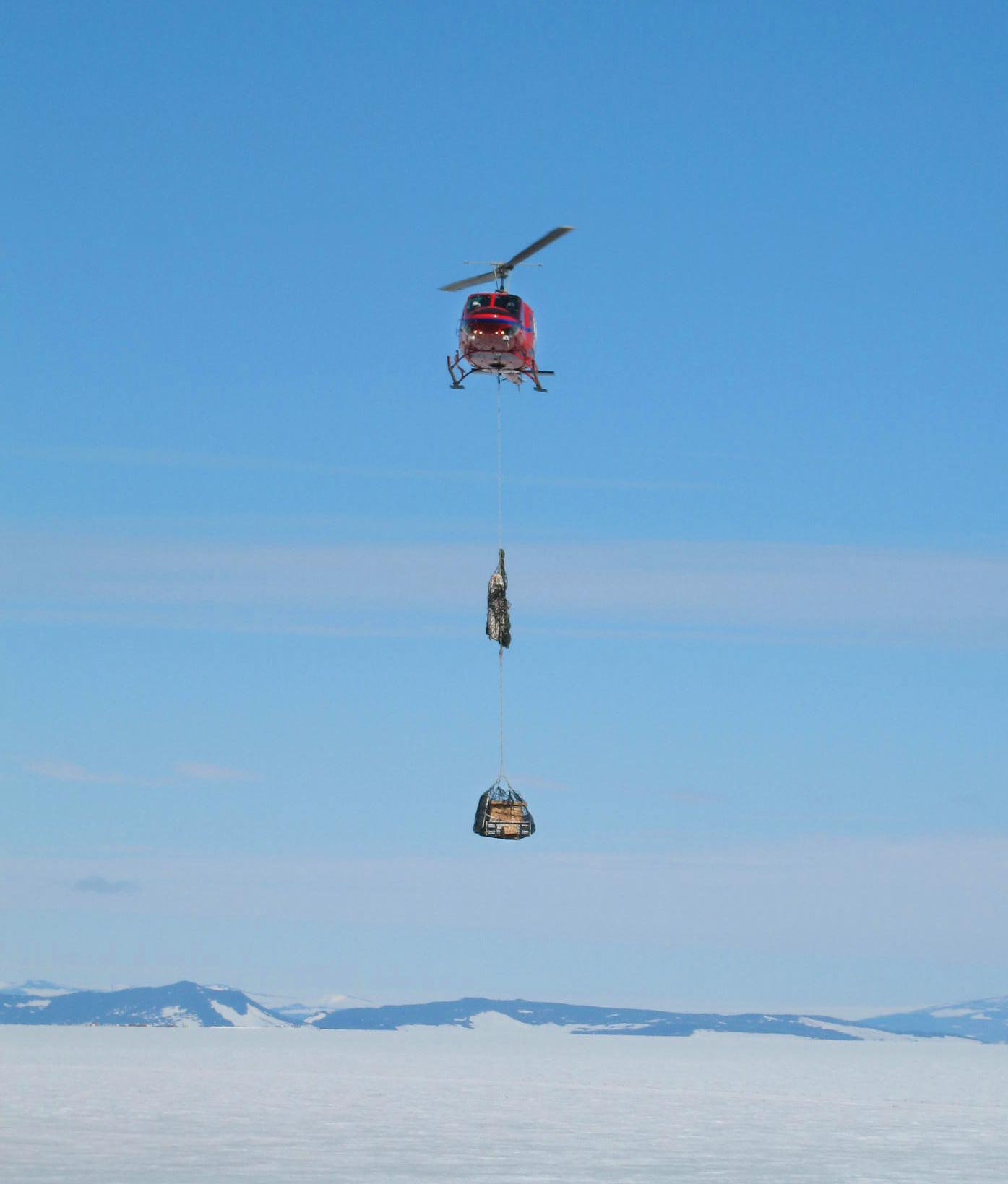
Almost 100 years after the South Pole was reached by Amundsen and Scott, Stezelberger and Klein were camping on the ice and testing radio antennas for observing neutrinos. A helicopter dropped the pair off at their campsite, along with their camp manager, Martha Story, from the Berg Field Center. A while later, the helicopter returned, carrying a sling load with much of their equipment. When the helicopter left, they were on their own on the ice.
They made camp, which consisted of three sleeping tents, one for each member of the team, a mess/work tent, and a tent with a lavatory.
“As tent options, I picked one that was taller,” explains Stezelberger, who is taller. “And it’s the type of tent that Scott used over a hundred years ago when he made his trek to the pole. A little bit more modern materials, like there is Velcro in it. But otherwise, same design.”
They had VHF and HF radios, as well as a satellite telephone and internet, which were needed for scientific purposes. They were required to check in frequently, and a missed check-in would result in a rescue crew being dispatched if communications could not be re-established.
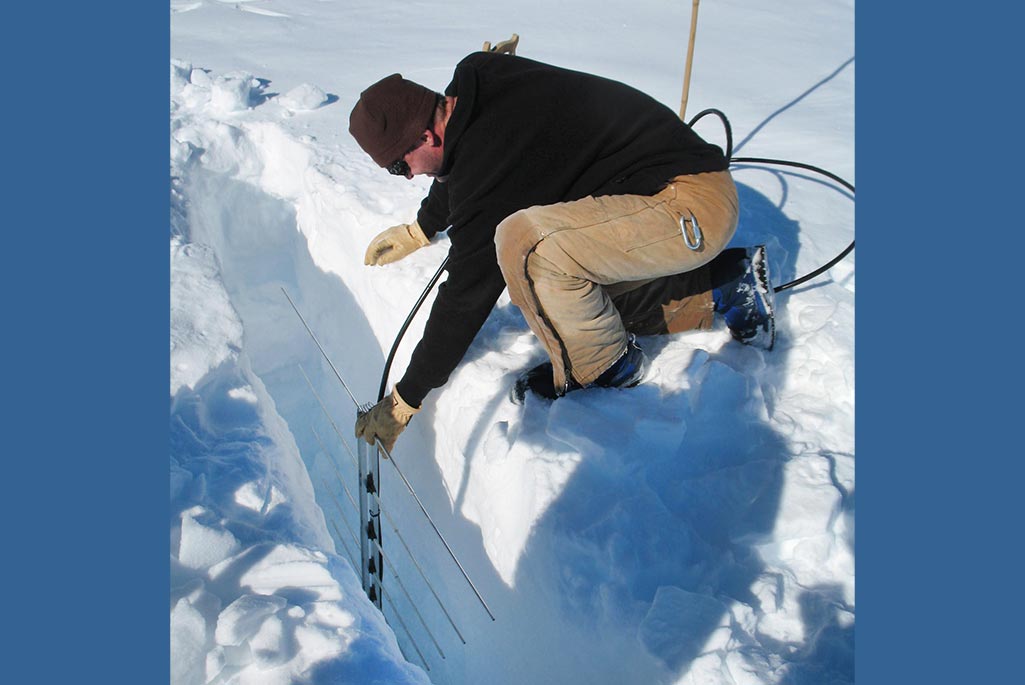
Over the course of their stay, they assembled antennas, set up test stations, and took measurements. Each antenna hole was hand-dug by the team.

Camp on the Ross Ice Shelf, with the mess tent on the far right and Stezelberger’s tent to the left of that. (Credit: Spencer Klein, Berkeley Lab)
“The holes were actually not that hard to dig,” Stezelberger says. “I’m usually an early riser. And with the sun being up twenty-four-seven, I was up early, and both Martha and Spencer were still in their tents. And, so I said, hmm, let me see how it is to dig. And by the time they were up, I had dug almost an entire hole for testing.”
Even with the holes being relatively easy to make, there was much work to be done on site.
“I think the hard part was juggling a lot of things, because a lot of pieces needed to come together. Everything needed to work for the station to work,” Klein explains. “And there were a lot of measurements that we needed to make. I’ll give you a simple example: antennas are designed to work in air. If you put them in ice, their characteristics change, so you have to make sure you understand that and what the impact will be. There’s just a huge number of different things to deal with.”

Spencer Klein (left) and Martha Story (right) digging antenna holes at their camp on the Ross Ice Shelf. (Credit: Thorsten Stezelberger, Berkeley Lab)
The nine-day camping expedition turned into 11 days when the helicopter was unable to retrieve the crew on time due to weather and fog. Fortunately, they had enough supplies to comfortably ride out the extra days, though they were running low on hot meals by the end. During their time camping, they only saw one other living soul: a skua – a large, Arctic scavenging seabird. The skua kept its distance.
“I would say the ARIANNA trip was a big success,” Klein comments. “We installed the station, and it continued to work. We took data and learned a lot. And personally, I thought it was a reasonably comfortable trip. We ended up all friends, which I don’t think always happens.”
Observations from ARIANNA have informed more recent experiments. The Radio Neutrino Observatory Greenland — or RNO-G — employs some ARIANNA-style antennas today. IceCube is still taking data, and papers are still being published.