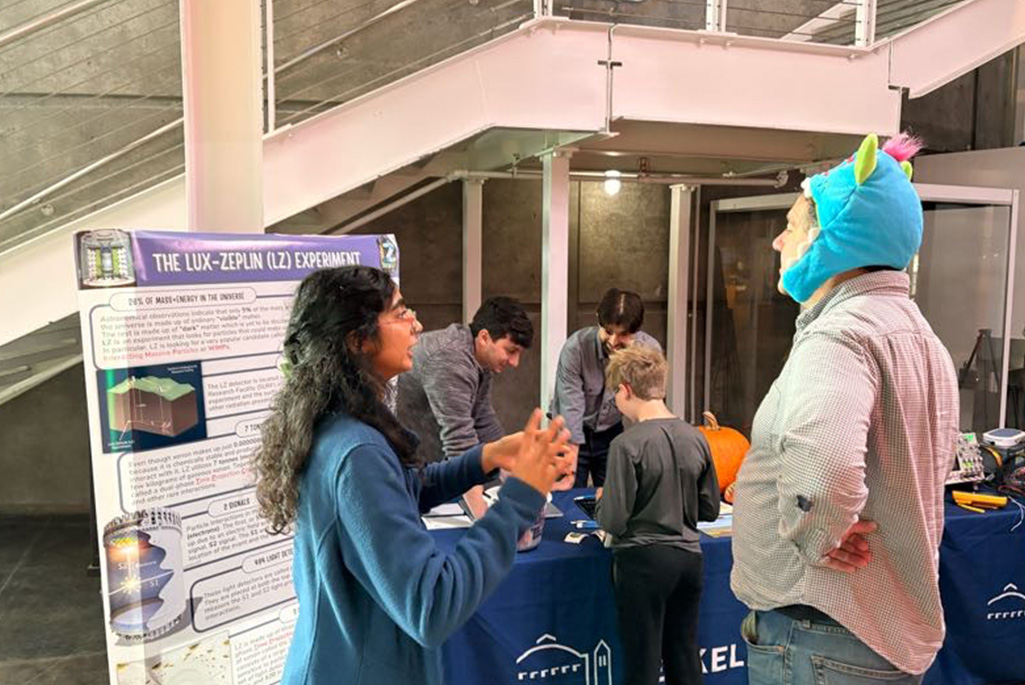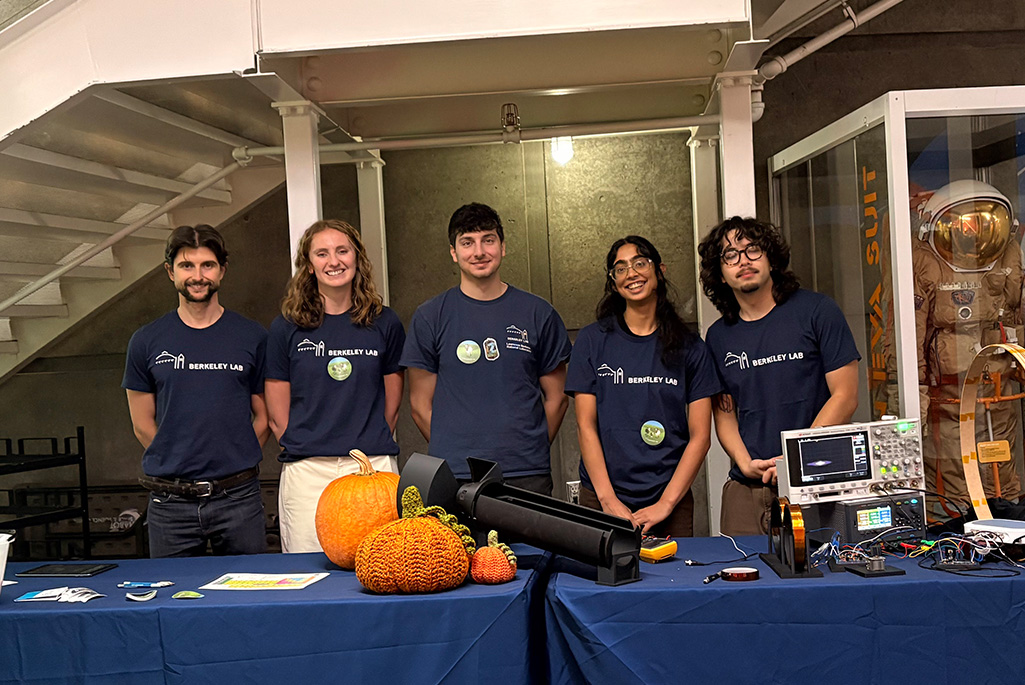
Berkeley Lab physicists hosted 2026 Dark Matter Day interactive activities for all ages at a “Spooky Science” event at the Chabot Space and Science Center in Oakland on October 31.
Participants engaged in hands-on activities with Berkeley Lab physicists to learn about dark matter and the experiments leading the way in its detection, including the Berkeley Lab-led LUX-ZEPLIN (LZ), TESSERACT, and CAL-Pathfinder dark matter experiments, which aim to observe dark matter interactions with earth-based detectors.
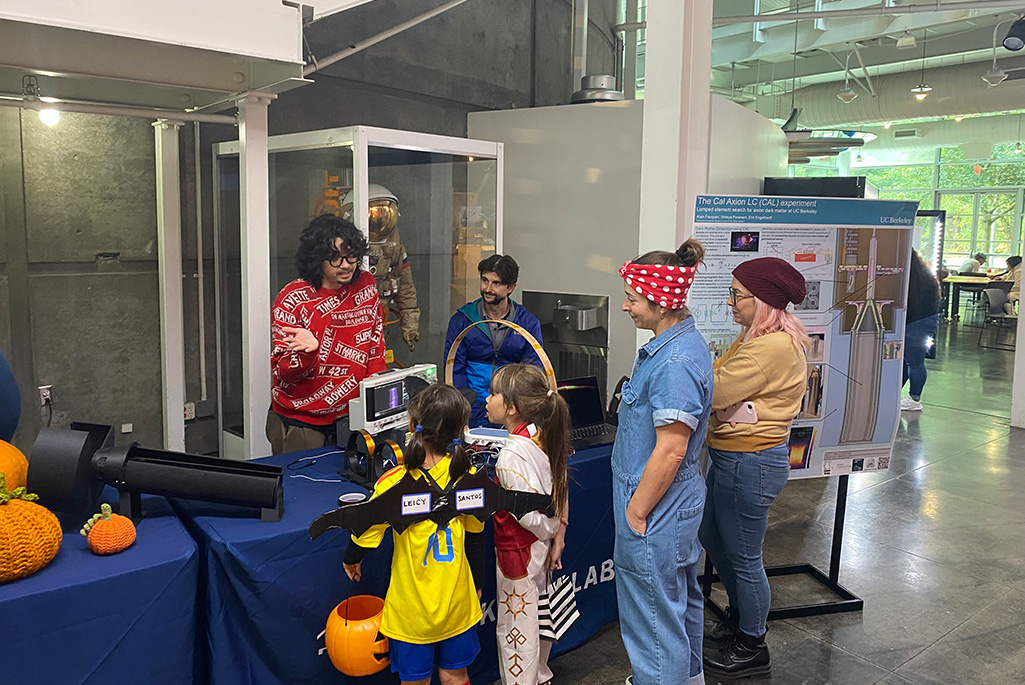
Ibles Olcina looks on as Brennan Coffey demonstrates CAL-Pathfinder’s ‘Dark Matter Radio.’ (Photographer: Dan Kodroff, Berkeley Lab)
The team hosted a demonstration table with media and displays highlighting Berkeley Lab’s work on the LZ and TESSERACT, as well as a hands-on activity illustrating the search for axions, an ultralight dark matter candidate that behaves like a continuous wave washing through the universe. To help visitors experience how experiments like CAL-Pathfinder’s ‘Dark Matter Radio’ scans for these kinds of wave-like signals, Brennan Coffey developed and led an oscilloscope-based demonstration that enabled visitors to step into the shoes of experimental physicists, searching for hidden resonant frequencies in the same way we look for hidden axion signals.
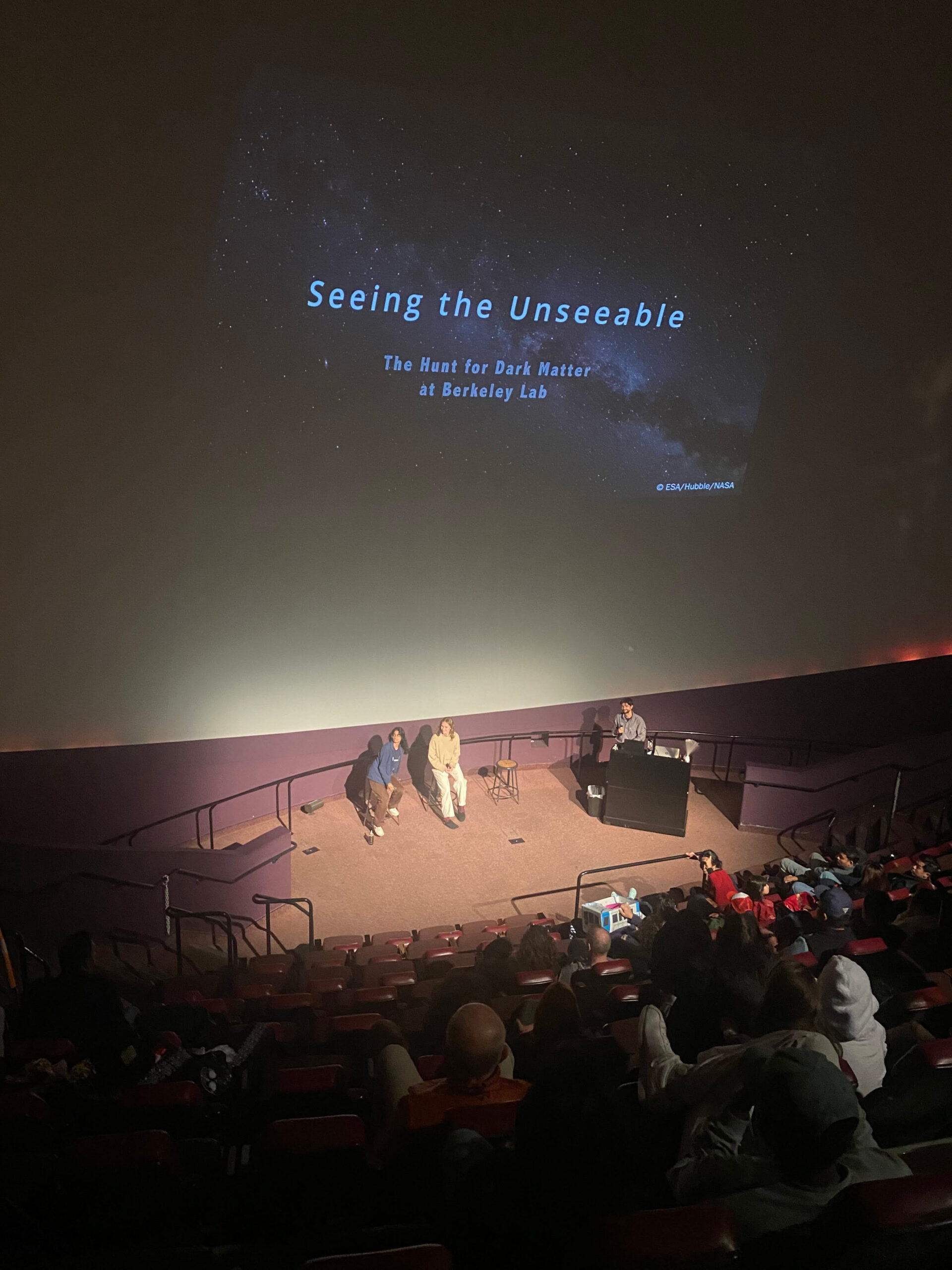
Shreya Puranam, Emily Perry, Ibles Olcina (at the podium), and Dan Kodroff (not pictured) hosted a post-film Q&A session with the audience. (Photographer: Dan Kodroff, Berkeley Lab)
In the afternoon, the team hosted the premiere of Berkeley Lab’s new dark matter video, Seeing the Unseeable: The Hunt for Dark Matter at Berkeley Lab, in Chabot’s auditorium. The film presentation was followed by a lively Q&A session with audience members about a wide range of topics, including how researchers find evidence for dark matter, the different types of dark matter candidates and how they are detected, the societal impacts of detecting dark matter, how AI is impacting current research, and potential career paths in physics.
“This is the third year we’ve partnered with Chabot to celebrate Dark Matter Day,” said Emily Perry, a Chamberlain Postdoctoral Fellow in Berkeley Lab’s Physics Division, who co-organized the Berkeley Lab team and co-wrote the dark matter film with Daniel Kodroff, another Berkeley Lab Chamberlain Postdoctoral Fellow. “The addition of the video premiere and live Q&A was a great opportunity to share Berkeley Lab’s cutting-edge dark matter research with the East Bay community,” said Perry, “and it really highlighted the genuine curiosity and joy people experience when engaging with our science. The curiosity and knowledge the kids brought to the table and Q&A blew us away.”
Dark Matter Day has been sponsored annually since 2017 by the Interactions Collaboration, a global community of particle physicists at laboratories in Europe, North America, and Asia, which supports international particle physics collaboration.
“It is so refreshing to talk with these kids and their parents about the work we do at Berkeley Lab,” said Ibles Olcina, a joint postdoctoral researcher at Berkeley Lab and UC Berkeley. “Their curiosity is energizing, and it is a joy to share the excitement of the hunt for dark matter with them. I bet we met some future scientists!”
Dan Kodroff and Emily Perry talk with event participants.
(Photographer: Ibles Olcina, Berkeley Lab)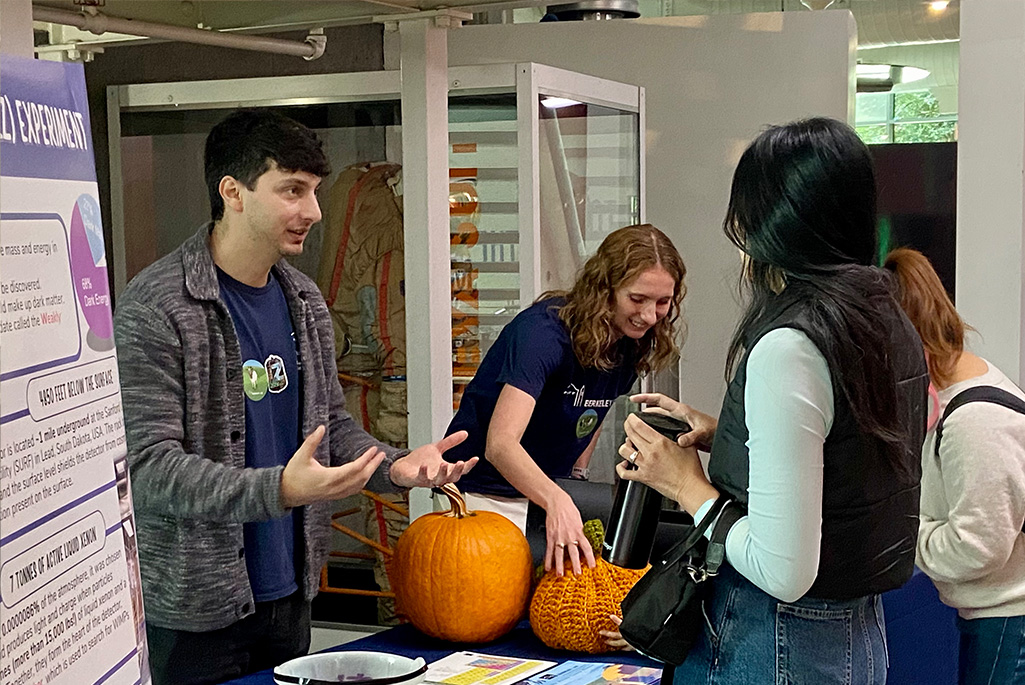
Shreya Puranam talks LZ with an event participant, while Dan Kodroff and Ibles Olcina show a young visitor an online presentation of the LZ experiment taking data in real time and explain how it searches for dark matter.
(Photographer: Emily Perry, Berkeley Lab)