
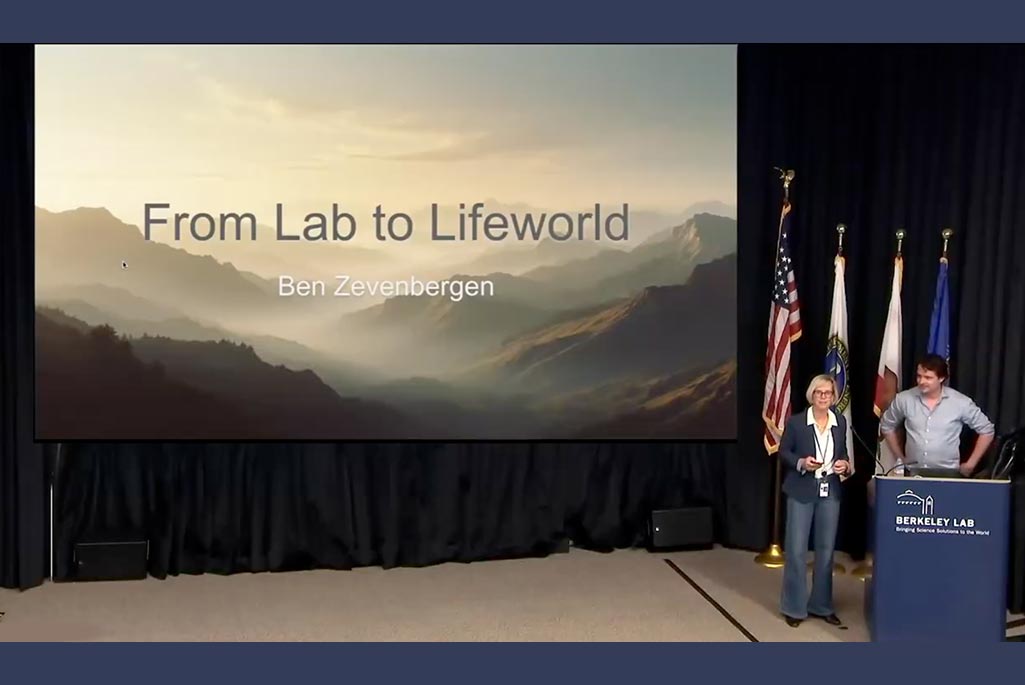
Most recently a Responsible Innovation Ethics & Policy Advisor at Google, Zevenbergen draws on his diverse academic and professional background in law, communications, social sciences, technology policy, and the philosophy and ethics of technology development, to emphasize the importance of responsible AI/ML use and ethical stewardship in scientific research. He visited Berkeley Lab on September 30, 2025, to present this talk on some of the methodologies he’s used to engage researchers, engineers, and technology developers in ethical decision-making. Review the talk abstract and speaker bio, presented below, watch/listen to the video (YouTube, 1:02:45), and read the transcript, which includes links to related recommended reading materials.
Abstract:
Scientists and engineers at research labs push the frontiers of knowledge that help to create new foundational technologies. These innovations fundamentally reshape our world, how our societies are structured, and our sense of being human. This “Deep Tech” work is characterized by technical complexity, long development horizons, and a mission-driven ambition to inform or solve some of humanity’s greatest challenges.
With this power to change the world, comes with a strong set of as yet ill-defined responsibilities. We often operate in a “policy vacuum” where the pace of discovery outstrips the development of law and social norms. High-level principles and compliance checklists can provide necessary guardrails, but they are often insufficient for navigating the novel and complex trade-offs that arise in the daily work of science and design.
This talk introduces Moral Imagination, a tried and tested bottom-up methodology for responsible innovation that reframes ethics as a core competency for scientists and engineers. The talk will introduce the rich philosophical tradition that sees ethical deliberation as a creative, forward-looking, and enabling method, rather than a restrictive anchor to the past. The method will be illustrated with examples from practice. The Moral Imagination methodology provides a practical approach for teams to fulfill their duty of stewardship. It was developed and operationalized iteratively through many workshops with engineering and product teams at Google.
About the Speaker:
Ben Zevenbergen is an advisor and researcher covering the philosophy and ethics of technology development. Most recently, he was a Responsible Innovation Ethics & Policy Advisor at Google. Before that, Ben completed a postdoc at Princeton, earned a PhD at Oxford, worked on tech policy in the European Parliament, and practiced as a tech law attorney in Amsterdam. He is particularly passionate about interdisciplinary collaboration across academia, industry, government, and policy, exploring how technology can be designed and implemented responsibly in society. Ben is currently launching his own venture.
