
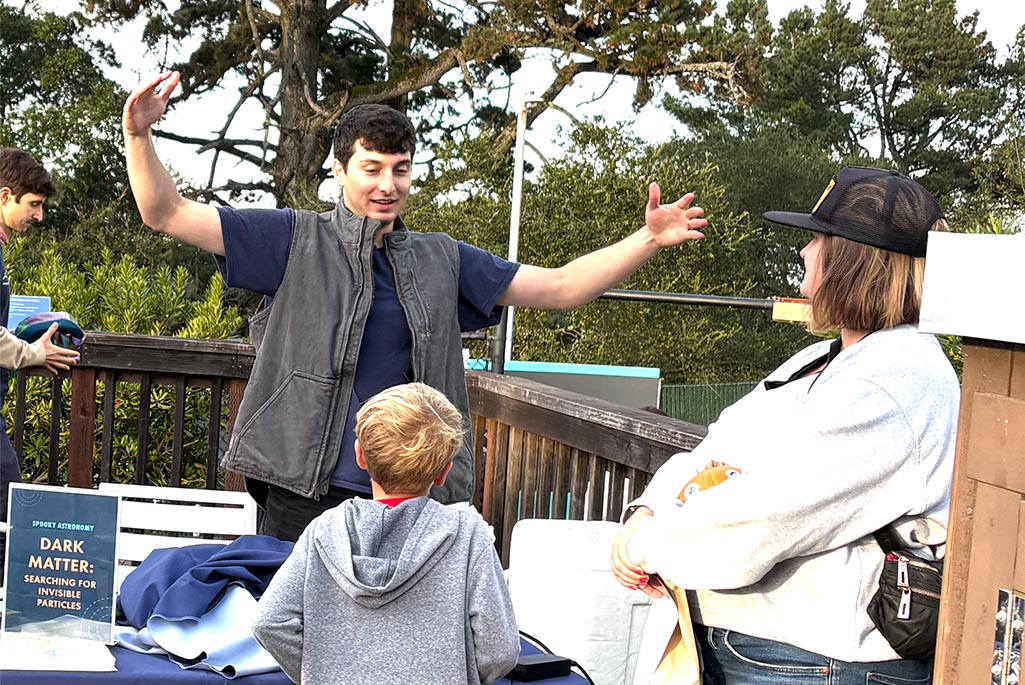
Berkeley Lab physicists hosted 2025 Dark Matter Day outreach events with interactive programs for all ages at the Chabot Space and Science Center in Oakland on October 24.
Participants engaged in hands-on activities with Berkeley Lab physicists to learn about dark matter and the experiments leading the way in its detection. Berkeley Lab leads the LUX-ZEPLIN (LZ) and TESSERACT dark matter experiments, which aim to directly observe dark matter interactions with earth-based detectors.
“It was great to introduce participants to the spooky universe of dark matter and share our research at LBL and how dark matter detectors work,” said Dan Kodroff, a Chamberlain Postdoctoral Fellow in Berkeley Lab’s Physics Division, who organized the event.
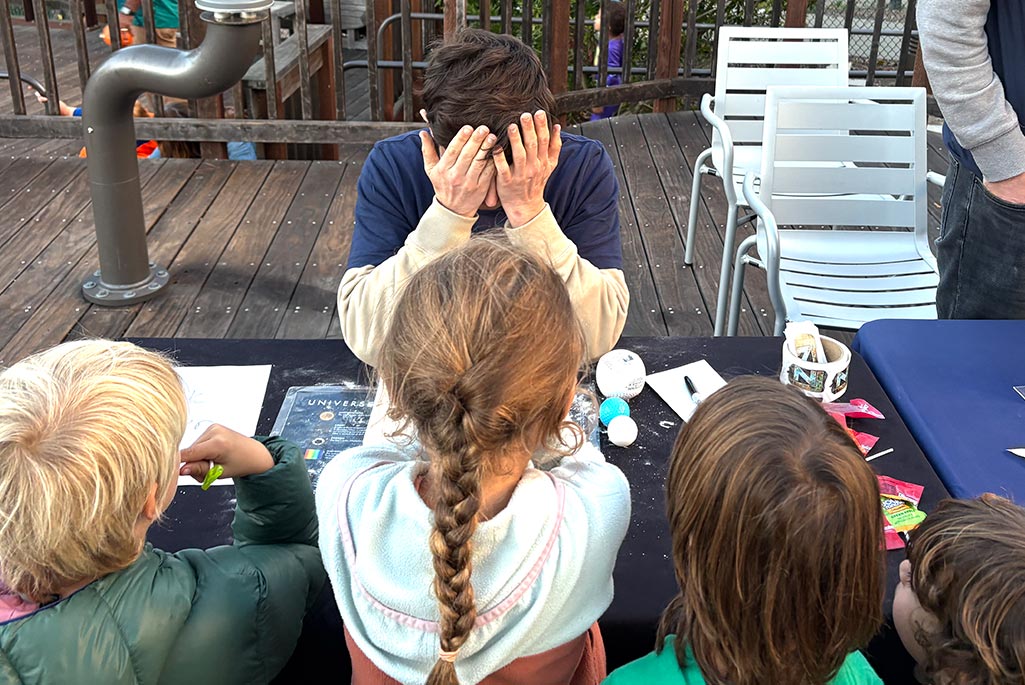
Since we can’t see dark matter, we have to rely on the signatures it leaves to detect it. Ibles Olcina instructs young event participants to cover their eyes to set up a demonstration about how scientists use detectors to search for dark matter. (Credit: Emily Perry, Berkeley Lab)
Hands-on activities featured a demonstration of cosmic ray tracks using a cloud chamber, a hands-on experiment illustrating how dark matter detectors function, where participants searched for imprints of various balls (particles) dropped (interacted) with a dish of flour (detector), and a creative exercise where participants drew their interpretation of dark matter’s appearance.
“The blend of Halloween excitement and hands-on dark matter activities at Chabot was a fantastic success. It was truly rewarding to see people of all ages engaged in the science behind our work,” said Emily Perry, also a Berkeley Lab Chamberlain Fellow. The team of Berkeley Lab volunteer hosts also included Ibles Olcina, a joint postdoctoral fellow at Berkeley Lab and the UC Berkeley’s Physics Department; and David Woodward, a Berkeley Lab project manager for the LZ Experiment.
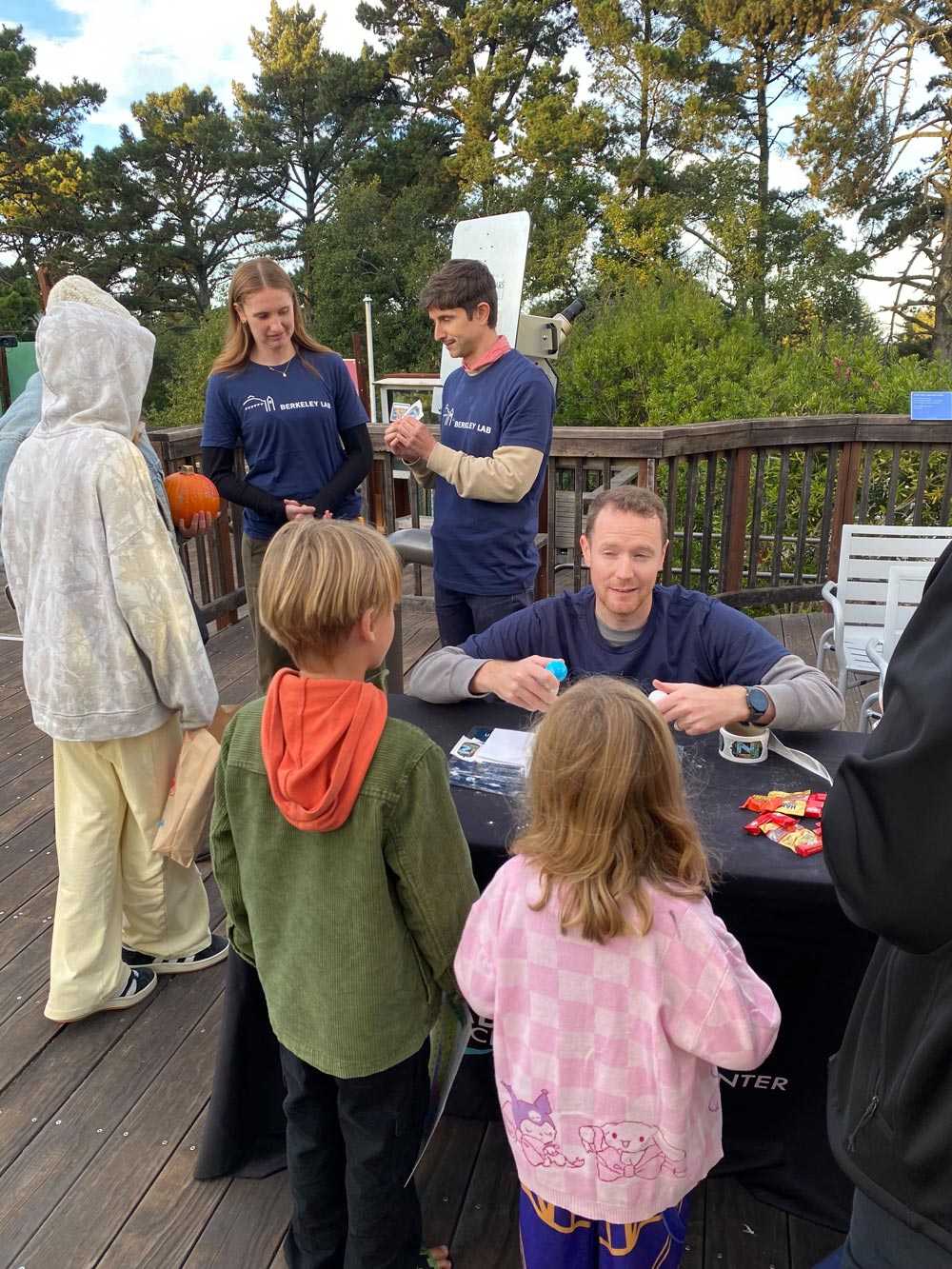
At left (background), Emily Perry (left) and Ibles Olcina talk with event participants while David Woodward (right, at the table in the foreground) sets up a detector demonstration with some of the younger participants. (Credit: Daniel Kodroff, Berkeley Lab)
Dark Matter is a term that physicists use to refer to the mysterious and unknown substance that is thought to make up about 27% of the total mass and energy in the known Universe. Dark Energy, which is theorized to be driving the universe’s accelerating expansion, accounts for another 68%. Researchers learn about Dark Matter and Dark Energy by studying their gravitational effects on the remaining 5% of known matter in the Universe, which includes everything from atoms and gases to planets, stars, and even black holes.
Dark Matter Day has been sponsored annually since 2017 by the Interactions Collaboration, a global community of particle physicists at laboratories in Europe, North America, and Asia, which supports international particle physics collaboration.
Stay tuned for upcoming results from the LUX-ZEPLIN (LZ) and TESSERACT experiments and other exciting dark matter research at Berkeley Lab.

Berkeley Lab’s 2025 Dark Matter Day volunteers (from left to right) Ibles Olcina, Daniel Kodroff, David Woodward, and Emily Perry. (Credit: Special thanks to an anonymous Chabot event coordinator.)
