

This summer, a team from the Engineering Division worked on the manufacturing and fabrication of the third-generation VENUS (Versatile ECR ion source for NUclear Science) plasma chamber for the 88-Inch Cyclotron. Construction of this instrument drew on incredibly specialized skill sets within the Division, and required collaboration between seven technical staff members and the 88-Inch Accelerator group to produce. The piece includes about 30 individual components, which were fabricated and assembled over 350 hours of machining, welding, leak detection, and ultra-high-vacuum cleaning.
The plasma chamber consists of an extra-long mandrel, capped with a flange on one end. The mandrel section of the piece began as raw stock, which was turned and bored on a manual lathe by machinists. The mandrel was then passed to Arnel DeLeon who machined the faces of the piece using a 5-axis milling and drilling machine. Not only did the work require a high degree of precision, but there was limited clearance inside the machine during this process.
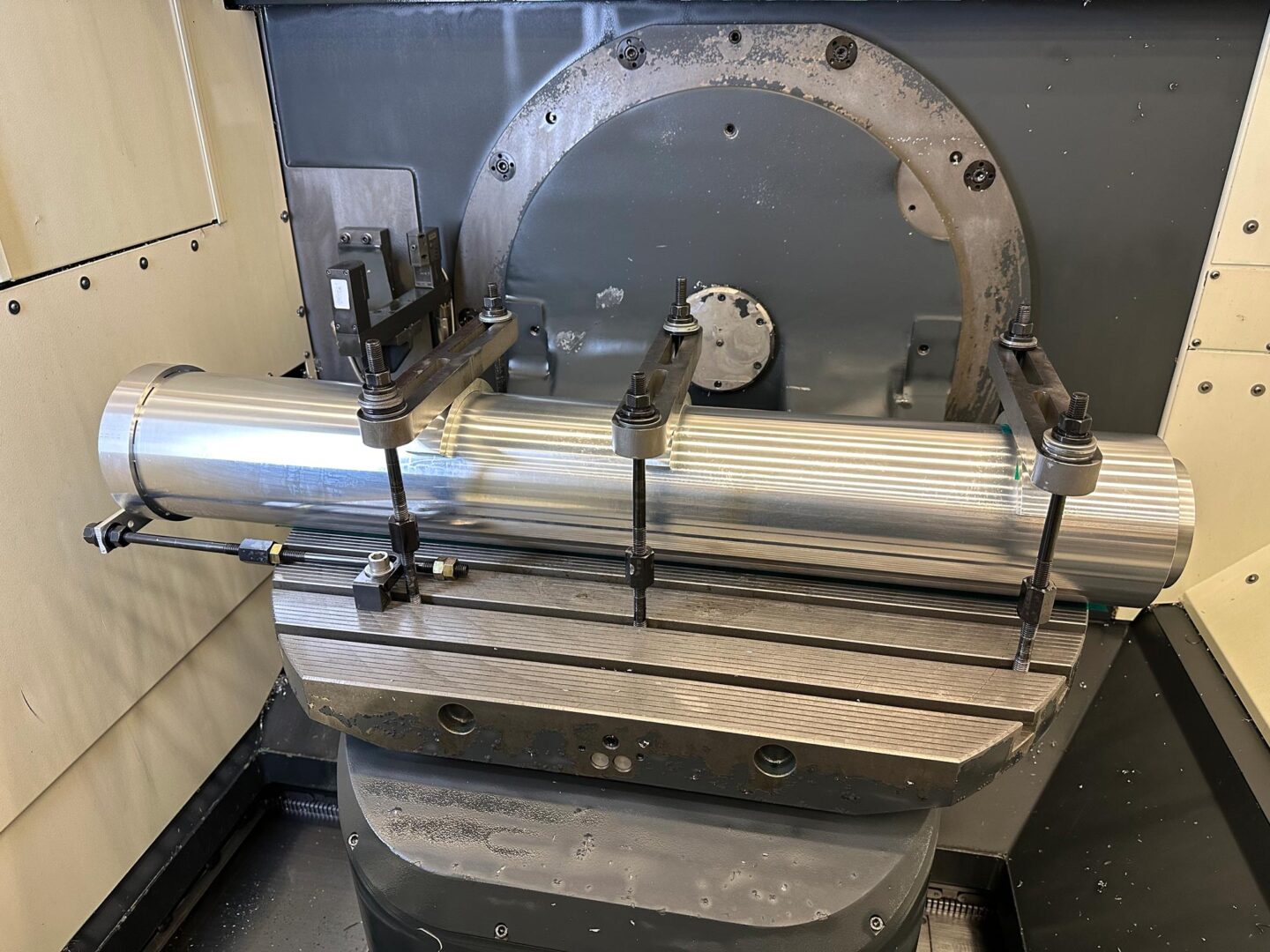
“One of the more challenging aspects was managing those tight clearances while maintaining accuracy on the deep and radiused holes,” explains DeLeon. “The setup and toolpath planning had to be carefully thought out to avoid interference and ensure smooth motion throughout the machining cycle.
“What I’m particularly proud of is how everything came together despite the confined space and the length of the part. It was a demanding setup, but seeing the final fit and finish made it very rewarding.”
After DeLeon completed his work on the mandrel, machinist Bun Pa Lim took over work on the project, milling the channels and slots for the device.
Lim explains: “I machined the mandrel on the CNC milling machine. It was machined between a rotary head and tailstock support because it was long and thin, which limited my maximum spindle speed, feed rate, and use of a small end mill. While machining the large channels, the spindle speed had to be reduced to about 3500 rpm and the feed rate down to 45 inches per minute for a ⅜-inch end-mill, which is quite slow for aluminum.”

Another challenge emerged as work on the device advanced.

The end setup on the CNC lathe, showing work on the plasma chamber’s flange. Credit: John Ilmberger, Berkeley Lab
“As this assembly of parts progressed, it became more critical to not make any mistakes because it would mean having to start all over again from the beginning,” says machinist John IImberger, who worked on the plasma chamber’s flange.
Beyond machining, welding the VENUS plasma chamber together requires an immense amount of technical expertise. The device must be ultrahigh-vacuum-tight. The initial design of the chamber was so challenging that it took welder Jon Courtney about three months to put together.
“The first design we had was something that was just on the verge of being unable to be made,” Courtney says.
Courtney worked with mechanical engineer Jaime Cruz Duran to modify the design so that it was easier to manufacture. Cruz Duran changed the locations and dimensions of some of the features on the flange to make welding easier, which helped cut the weld time down to about two weeks.

A detail of welding on the VENUS plasma chamber. Credit: Kris Pearson, Berkeley Lab
“Jaime came and actually listened to what everyone can and can’t make,” Courtney adds. “He was open to design changes that would allow me to weld the piece successfully.”
The VENUS plasma chamber remains unmatched in performance within the electron cyclotron resonance (ECR) ion source community. VENUS is an aluminum chamber that is fully metal sealed making it ultrahigh vacuum compatible and capable of high-power plasma operation.
###
Made in Berkeley Lab is a series about the many innovative and groundbreaking items the Engineering Division makes on location, showcasing the highly skilled fabrication and manufacturing expertise at the Lab. From tiny robots and tight tolerances to mammoth detectors, powerful magnets, and new materials, it’s all made right here in Berkeley Lab.
