
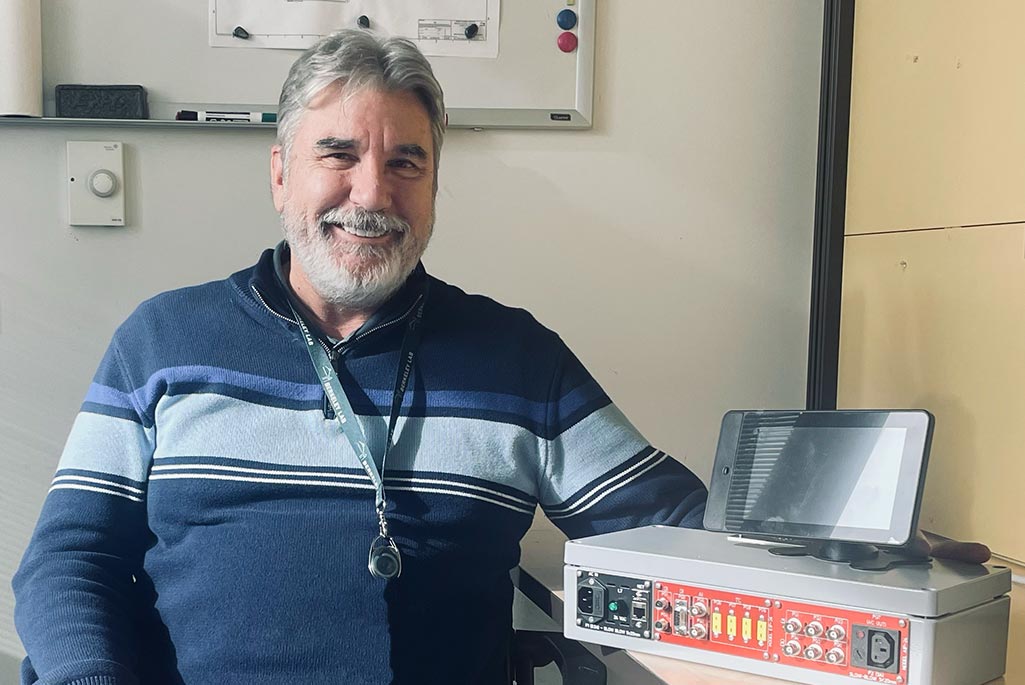
Equipment protection interlock systems are a vital component of the infrastructure for many types of scientific equipment and facilities, especially at Berkeley Lab facilities like the Advanced Light Source (ALS), BELLA, and the Joint Genome Institute. These specialized interlock systems control the mechanisms that prevent unsafe conditions when using equipment. Actions like protecting beamline slits and components from overheating fall to interlock systems that have been custom-configured to meet the specific requirements of equipment and experiments. The Engineering Division is currently piloting a system for Berkeley Lab that will make setting up and using equipment protection system interlocks safer, faster, and more consistent—with minimal training and no need for coding on the user side.
This new tool has been developed at the ALS in collaboration with the European Synchrotron Radiation Facility (ESRF). The underlying idea for the interlock system comes from ESRF, where more than 400 of the devices are already in use. When Ernesto Paiser, ALS Instrument Software Support Group Lead, formerly of ESRF, arrived at Berkeley Lab, he saw an opportunity to implement a similar system that would provide increased reliability and flexibility while improving safety and efficiency.
“When I started at the Lab,” says Paiser, “I was immediately confronted with numerous challenges related to the equipment protection system (EPS). One of the most significant issues was how complex and inaccessible the system was for end users when they needed to define or modify interlock requirements at the end stations. Even a minor request often required changes to the main front-end interlock program. Each modification triggered a full system retest, regardless of the scope of the change. In many cases, by the time the work was completed, the original request was no longer needed, yet the changes remained permanently embedded in the system.”
This process was inherently slow and resource-intensive. Designing the solution, writing the code, producing the hardware, and performing comprehensive testing typically took several weeks—and sometimes more than a month—before a request could be finalized and deployed.
By contrast, at ESRF, the equipment protection interlock systems are noticeably simpler and faster to implement. The ESRF Beamline Controls Group relies on decentralized devices, allowing them to respond quickly to new interlock needs without depending on a large team of PLC specialists. This approach is both practical and efficient.
“Inspired by this model, I proposed establishing a collaboration and adopting the same philosophy at Berkeley Lab,” explains Paiser. “The goal was to rethink how interlock systems are designed and deployed, focusing on an architecture that empowers users while reducing development overhead. Simplicity, reliability, and flexibility became the three guiding principles of this effort—key attributes to ensuring the long-term success of these devices at Berkeley Lab.”
Designing with vision
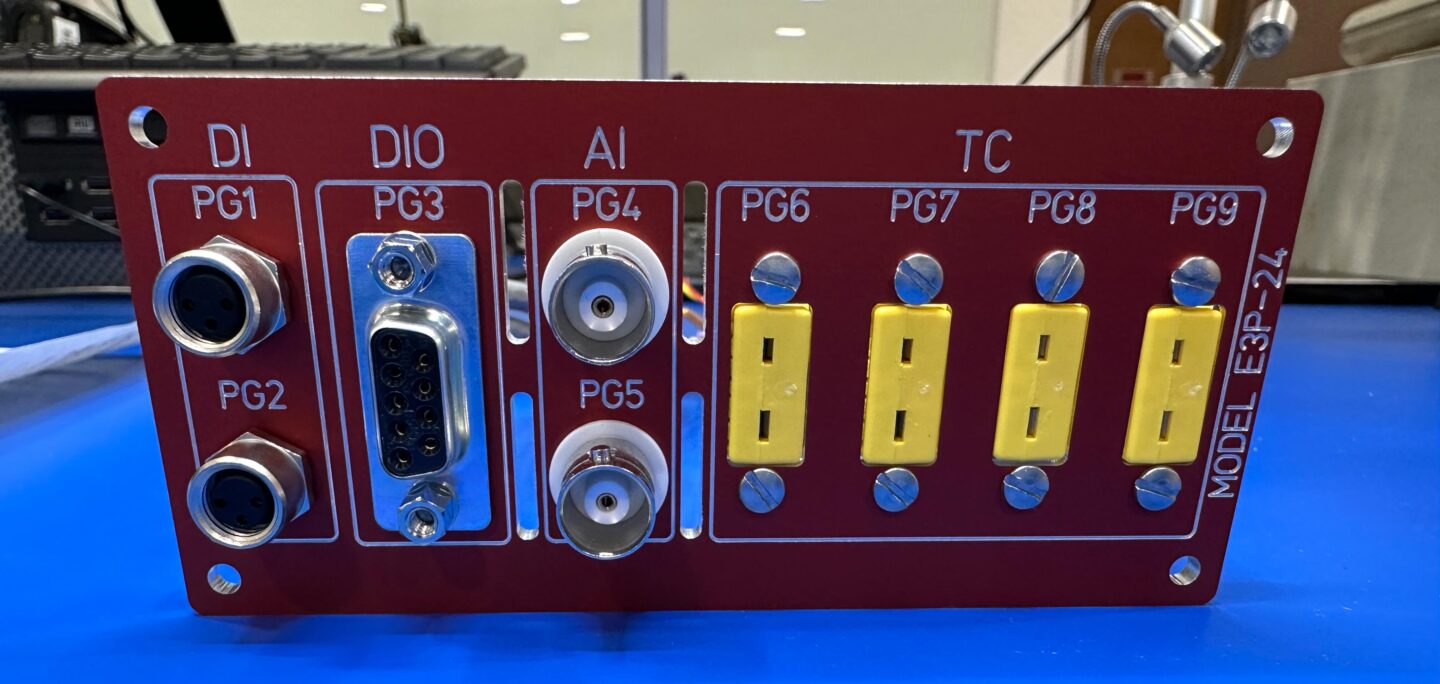
The new interlock system is composed of three parts: a programmable logic controller (PLC), which uses unique code provided by ESRF; user software written by Paiser; and hardware, which was designed and managed by electronics engineer Chris Toy. The hardware leverages the original box design from ESRF, off-the-shelf internal components, and face plates—the panels that provide the interface between the box’s electronics and the exterior world—which underwent a small amount of customization.
“The idea is really fantastic because it’s simple and doesn’t require experts in order to operate it,” explains Paiser. “You don’t need to program anything. It is very flexible because this box has face plates that you can adapt for any experiment or any kind of application.”
A huge advantage of the tool is that it combines a user-friendly software interface with flexible preassembled face plate kits. These face plate kits cover most user input/output needs, such as analog and digital inputs, thermocouples, analog and digital outputs, and AC power control. A graphical interface allows users to create and edit configurations, and connect inputs and outputs like sensors, thermocouples, valves, or relays, and test them in just a few minutes—all without writing a single line of code. The system supports WAGO 750-series PLCs and a variety of modules, making it adaptable to different experimental setups. Built-in tools help track changes, manage user access, and ensure consistent operation across different lab areas.
Engineering the details
For users, the less they notice of a system like this, the better. But for engineers like Chris Toy, the beauty of the system is in the smallest details—and in creating a tool that is highly reliable, modular, and functional.
As part of his work on the project, Chris Toy made a number of small but important changes that simplify maintenance and operation, including modifications to the original design of the hardware in order to adapt the device for use at Berkeley Lab and ensure its performance, longevity, and compliance. For instance, he worked on the connector plates to make the hardware fully compliant with the electrical safety code at the Lab. He also replaced the fixed LED on the face plate with an LED that can be easily replaced, added ventilation holes as a proactive measure against overheating, and added a modular socket to the power cord to allow clean external cabling at the correct length, avoiding the need for power strip connections. All these modifications have also been adopted by our ESRF partners.
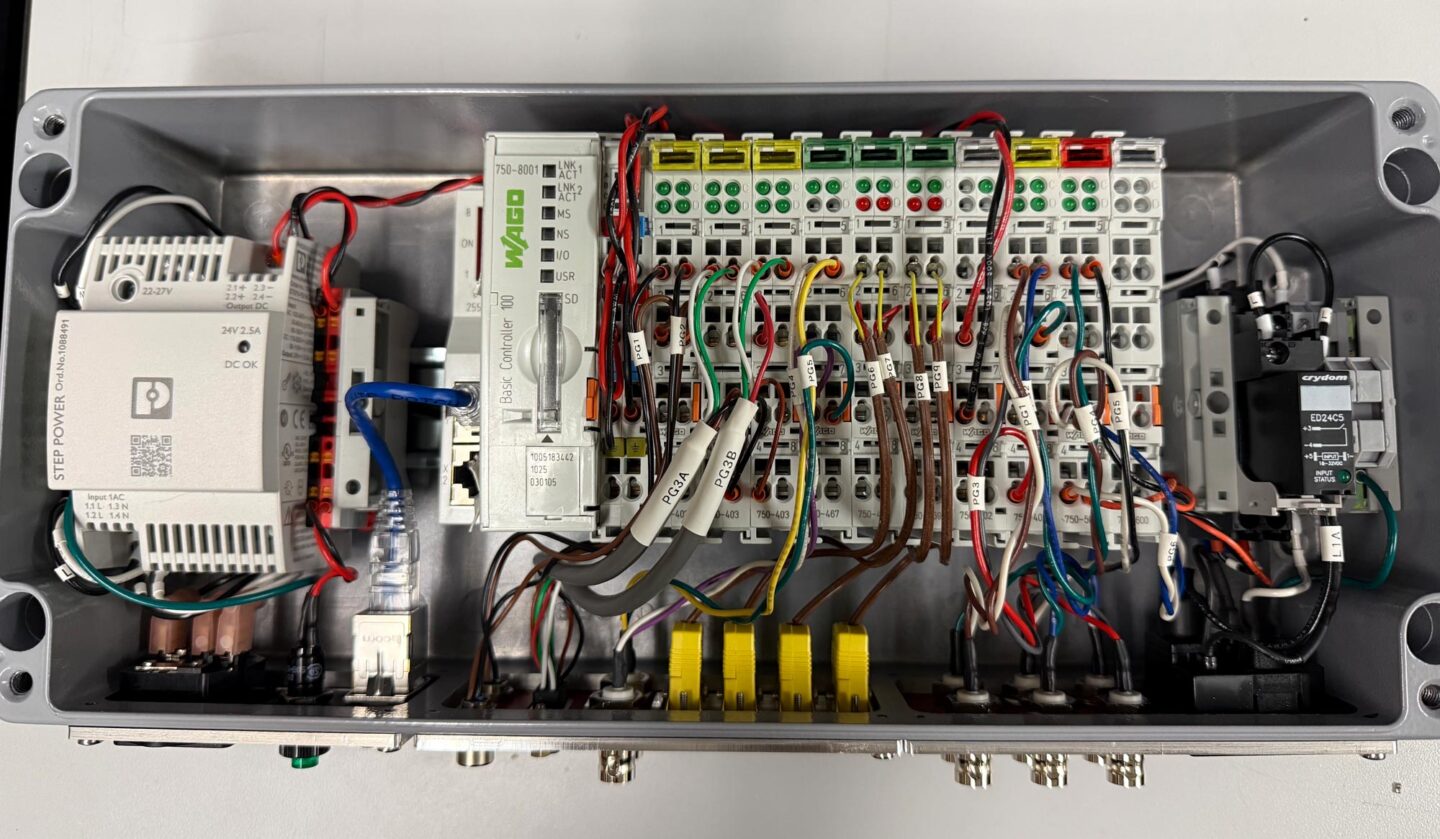
The interior of the box features a solid-state relay specifically selected for reliability and a metal-oxide varistor (MOV) to protect the relay and circuitry from the voltage surge that occurs every time the output load is turned on. Cable management within the box has been carefully thought out, including labeling each cable for easy troubleshooting.
Implementation
The first new equipment protection interlock systems have been implemented at the ALS. On Beamline 11.0.2, the system was tested on the liquid injection system to protect the main chamber.
“The beamline team contacted us, explained the problem, and we suggested the WAGO implementation and created some documentation,” says electronics engineer Danish Nawaz, who helped facilitate use of the new system. “We were able to have the system ready within a few days. This turnaround time is significantly faster than the weeks or months required for implementing a traditional engineered equipment protection interlock system. We worked closely with the scientists to gather and implement their requirements. We also utilized the expertise of the B80 electrical shop.”
The same system is also being piloted on Beamline 9902 and has wide-ranging applications across the Lab.
“We are gathering suggestions and requests from the users from initial tests of the systems,” said Paiser.
Based on feedback from the first test cases at Berkeley Lab, Paiser is working on incorporating a small display unit that will allow the beamline teams to reset or disable the interlock and operate the system locally without needing the interlock program installed on any beamline workstation. This display is being developed to address their requested improvements. Currently, 10 systems are ready to be deployed.
The Advanced Light Source (ALS) has provided full funding for the Engineering Division’s development of these equipment protection interlock systems since 2024, enabling its successful initiation and implementation at the ALS, as well as the team’s development of expanded applications for other facilities and experiments across Berkeley Lab.
If you are a Berkeley Lab user or researcher interested in testing and using this new system, please contact Ernesto Paiser.
