
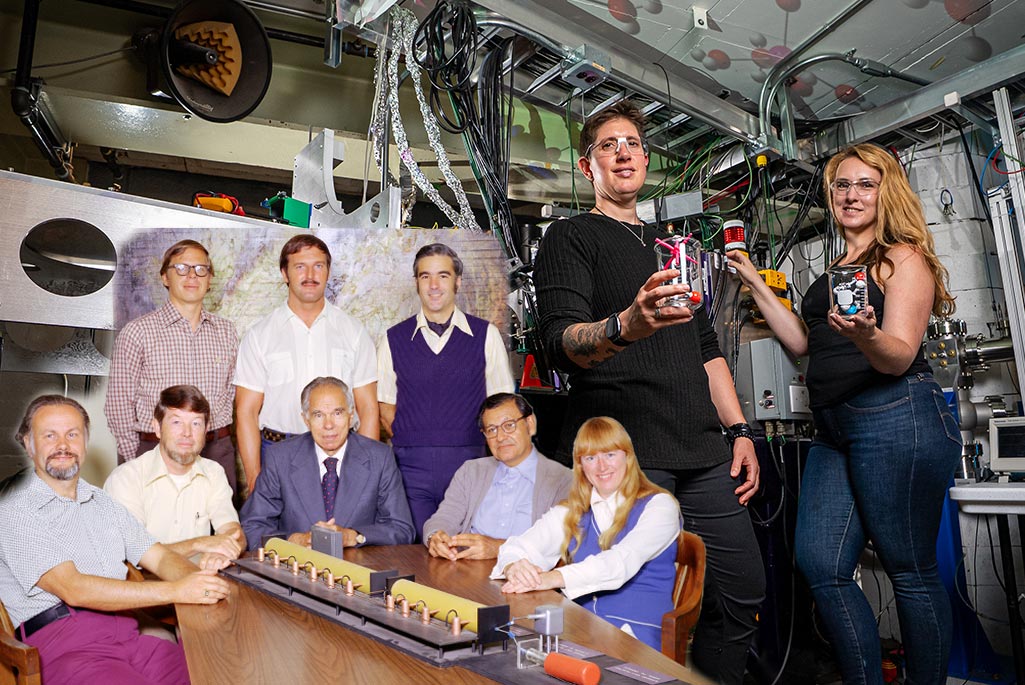
In this BBC Radio 4 podcast, cosmologist Andrew Pontzen talks with NSD’s Jennifer Pore and Jacklyn Gates, researchers in the Nuclear Science Division who are leading Berkeley Lab’s search for new superheavy elements. Also featured in this interview are José and Carol Alonso, two members of Berkeley Lab’s element 106 team who, 50 years ago, made the last new element to be created at Berkeley Lab. Pontzen also talks with author Kit Chapman about the fraught geopolitical history of element discovery.
This BBC Radio 4 podcast aired on September 10, 2025.
Podcast Audio Transcript:
_________
[ Intro, footsteps can be heard walking down a hallway, and we hear a door swing open ]
Jennifer Pore: We’re gonna go through the main doors into the cyclotron facility.
Andrew Pontzen: It’s like a kind of giant cavern with pipes running everywhere and a giant box in the middle of the cavern.
Jacklyn Gates: Yeah, so we’re actually standing directly outside of the main cyclotron vault. Separating us from the cyclotron is about 10 feet of concrete right now.
Andrew Pontzen: Is that a safety thing?
Jacklyn Gates: Yes, the radiation fields that the cyclotron generates when it is running are quite high, so this is to make sure that we can walk around here safely.
Andrew Pontzen: I’m on the hillside above Berkeley, California, and while it feels like I’ve entered an end-of-the-world bunker, I’m not here to witness destruction. I’m here to understand creation.
Jennifer Pore: My name is Jennifer poor, and I’m a research scientist working in the heavy element program at Berkeley Lab.
Jacklyn Gates: My name is Jacklyn Gates. I am the group leader of the heavy element group. We study superheavy elements. A superheavy element is any element with 104 protons or more. Back in the 40s, when we were beginning to understand nuclear science, we didn’t think that these elements could exist.
Andrew Pontzen: Now, these researchers have worked out how to make another one, how to manufacture an entirely new, superheavy element that has never before existed on planet Earth.
Jacklyn Gates: We have to make these in collisions, where we combine nuclei of two lighter
atoms together.
Jennifer Pore: So the cyclotron is the heart of every experiment that we do.
Andrew Pontzen: I’m Andrew Pontzen, and this is the search for element 120. Jacklyn Gates and Jennifer Pore at the Lawrence Berkeley National Lab are the latest leaders to tackle the hardest experiment in physics: making something totally new. I’m fascinated by processes of creation. My day job is studying the way that atoms, planets, stars, galaxies – and the entire universe – were formed over a tumultuous 13.8 billion years. Some of the heaviest, rarest elements like gold, platinum, and potentially even superheavy elements, are made in the collisions of neutron stars. People creating new elements here on Earth bring that remote universe a bit closer to home. Still, I’d like to get to the bottom of why anyone would go to the trouble of producing new elements, because it’s far from straightforward.
[ Footsteps and then voices from farther away ]
Andrew Pontzen: We’re now on top of the main particle accelerators.
Jacklyn Gates: Yes, we are directly on top, that hole right there is looking down into the cyclotron, if you were able to actually get your head there.
Jennifer Pore: You probably don’t want to get your head there.
Andrew Pontzen: It’s incredibly noisy. There are machines everywhere. They are joined with pipes. They’re joined with cables. I mean, it’s like something out of a Hollywood set designer’s fevered imaginations of what it’s like to be a scientist.
Jennifer Pore: So this is Venus, the best ion source in the world.
Andrew Pontzen: So an ion, it’s a bit of an atom.
Jennifer Pore: So an atom is made up of protons and neutrons that form a nucleus at the center of your atom, and then it’s surrounded by a cloud of electrons. You usually would have the exact same number of positively charged protons that you do negatively charged electrons, and they completely balance out that charge overall. But when we create an ion, now we remove one of these negatively charged electrons, and we have an excess of positively charged protons. So overall, the atom will have a positive charge,
Andrew Pontzen: And it’s the overall charge that lets you actually push this thing around and do interesting things with it?
Jennifer Pore: Yes, exactly, so the overall charge lets us use magnetic fields and electric fields to accelerate and move these ions to where we want them to go.
Andrew Pontzen: So what sets the superheavy atoms that you’re trying to make apart from these ones that you actually start with?
Jacklyn Gates: There are 90 elements that exist naturally here on Earth.
Jennifer Pore: We put 118 elements on the periodic table, and so to get the rest of those elements, we have to make them ourselves using nuclear reactions. You start with a beam, which are the ions that we’re talking about, and then you accelerate that ion onto a target, which is made up of a heavier nucleus, and you hope that in that nuclear reaction, they’ll fuse. And then you’re getting up to that almost 120 number for a superheavy element.
Andrew Pontzen: I’m just about keeping up. They take normal atoms, rip off the outer layers, and are left with the minuscule central nucleus that makes the atom what it is. Then, the colossal equipment is designed to accelerate and smash those tiny nuclei into other nuclei. If they do it just right, sometimes the nuclei will stick together, the result: a very heavy nucleus. In other words, the nucleus of element 120, perhaps within a year or two – on the timescales of scientific discovery, that’s imminent. This sense that the team could soon recreate what nature only manages in explosive, far-off, unfamiliar corners of the universe gives me a first taste of what’s driving them. To compete with the universe’s own approach to manufacturing, the nuclei must be given enormous energy, and that happens inside those foreboding concrete walls of the cyclotron.
Jacklyn Gates: This big gray thing, here, this is the yoke for the magnet that goes around the cyclotron. And then that window, there, is looking into the center region of the cyclotron.
Andrew Pontzen: So if I were to look in there, and I had the right kind of vision to be able to see these individual ions whizzing around really fast…
Jacklyn Gates: … you would see individual ions spiraling out from the center of the cyclotron, and then they come out through that pipe right there.
Andrew Pontzen: Just how fast are you trying to get these things moving?
Jacklyn Gates: We accelerate to about 10% the speed of light. Nuclei are protons and neutrons. Those protons are positively charged, so when you’re trying to bring two nuclei together, it’s like trying to bring two North ends of a magnet together. They’re going to repel each other. You need to bring them together with a lot of energy and a lot of force to overcome that repulsion. We do that with speed.
Andrew Pontzen: As well as getting them up to such high speeds, though, presumably, you need to get them exactly on target.
Jacklyn Gates: Yes and no. We never know where an individual nucleus is, right? They’re so tiny we can’t see them, so what we try to do is we try to shoot as many ions as possible in that general area, so we have as many chances as possible for nuclei to interact. We try to do 10 to the 13 a second – so something like 10 trillion ions a second – down our beam line and hitting our target. If we’re trying to make something like nobelium, which is 10 protons heavier than anything you can find on Earth, we can make like six a second. But if we’re trying to make something that we recently did with livermorium, which has 116, we got one atom in 10 days, and that was for an element that we already know. If we’re trying to make something new, it could be one every 100 or 200 days.
[ A bass-heavy beat is heard and slow techno music plays briefly in the background ]
Andrew Pontzen: All this time, energy, and expertise is being poured into just ‘potentially’ making one atom of the new element. I can’t put it off any longer. We take a break away from the machinery, and I ask Jacklyn Gates why they’re doing this.
Jacklyn Gates: I would answer this by actually going back to the early 1900s to Ernest Rutherford’s lab. He was really interested in alpha decay, this newly discovered type of radiation. He wanted to know, what happens if I fire these alpha particles through a thin gold foil, so he sent one of his colleagues off to do it. This colleague reported back that some of the alpha particles bounced off at really odd angles. Within a few years, it revolutionized the way we understand the structure of an atom, and that experiment, that laid the groundwork for a lot of modern day technology that we have today: computers, smartphones, nuclear fusion. In fact, I think a lot of the technologies that we have today have similar backstories. I can point to artificially produced elements that are used every day in applications today. So one is Americium, that is in smoke detectors in people’s houses. Californium, that is used to determine the foundation of your house, how dense it is. So a lot of these elements that we have discovered have practical uses, and that’s the research that we’re doing. We don’t know where this is going to lead us, but we hope that the discoveries that we make helps us find new technologies that we can’t imagine now, just like Rutherford couldn’t imagine smartphones in the 1900s when he was studying alpha decay.
Andrew Pontzen: Concrete scanners and smoke detectors are certainly life-savers, but this explanation doesn’t quite cut it for me. My own field, cosmology, is sometimes also justified by its practical offshoots, but these potted justifications don’t explain why we explore the universe. So to understand why anyone would want so badly to create a new element, I decide to talk to two scientists who have already done it.
[ Sounds of knocking and then a door opening ]
Andrew Pontzen: Hello!
José Alonso: Hello!
Andrew Pontzen: I assume you’re José?
José Alonso: Yes, that’s correct, yes.
Carol Alonso: Come on in guys!
José Alonso: And this is Carol.
Andrew Pontzen: Carol, hi, lovely to meet you. I’m Andrew.
José Alonso: Please come in!
Andrew Pontzen: I’ve taken a winding taxi ride through the Berkeley Hills to find the home of José and Carol Alonso, the two remaining members of a team who, 50 years ago, made the last new element to be created in the Berkeley Lab.
Carol Alonso: I pulled out those books from our 106 days. I haven’t looked at them in 50 years… This is me. I’m like, 22. [ Laughing ]
Andrew Pontzen: The picture you’re showing us is from around, around what time when you moved?
Carol Alonso: 1974, at the time that we discovered element 106.
Andrew Pontzen: That was just a few years after Carol and José moved across the country to join the Lab.
Carol Alonso: We were at Yale, working down in the basement with the computers, and the phone rang, and it was somebody calling from Berkeley, and he said, Glenn Seaborg would like you and José to come and work at Berkeley. Will you come? I didn’t even ask him. I said, Yes, we’ll come!
Andrew Pontzen: By this point Seaborg was a huge name already. What was he famous for at that point in time?
Carol Alonso: For all the elements he had discovered…
José Alonso: … and he, his Nobel Prize was for the discovery of plutonium. He was, he was quite famous, yes, there’s no question about it.
Andrew Pontzen: Glenn Seaborg had played a role in discovering 9 new elements. Alongside him in the lab was Albert, or Al, Ghiorso, who had already discovered 11. It was with these titans of nuclear physics that they began their new work.
José Alonso: I would come in in the morning, and they would give me the data tape to take down to the computer center to analyze. And Carol’s responsibility was more in the theoretical calculations.
Carol Alonso: This is the early days of doing computer simulations, and I was simulating two nuclei hitting each other… or trying to.
Andrew Pontzen: Of course, you and your team were working towards discovering element 106. Can you tell us a bit about the process?
José Alonso: It’s, on the surface, very simple, namely, 106 has 106 protons. So you want to get a target, which was Californium, which is 98 protons, and then oxygen, which is 8 protons. So that’s the two of them together is 106. So you bombard them, and if, if they fuse, then you’ve got element 106. We were seeing one element, one atom at a time…
Carol Alonso: … but you want, you want enough that is statistically believable for everybody else.
José Alonso: Yeah. So we ended up with about 60 or 70.
Andrew Pontzen: Around the same time, there was a team in Russia working on making exactly the same atom. Were you skeptical of what they were doing? How did you feel about about competition?
Carol Alonso: Skeptical all along, and in the end, even though they say today, they did it, they did not.
Andrew Pontzen: Do you think that reflects the political side to this? That there is a sort of national side to element discovery?
Carol Alonso: There always has been.
José Alonso: Especially in the Cold War.
Carol Alonso: In the middle of looking for element 106, I needed to go to a conference in Tennessee, and Al said to me, if you see any Russians, let me know. So I get there and I get in the elevator with four Russians, when they knew the Americans were going to announce that they’d found a new element. They had this habit of announcing that they had found it beforehand without data. It just bugged us. And sure enough, you know, there I am, the youngest member of the whole team, sitting in the front row, and this Russian comes down and he whispers to the Chairman, I thought, Oh my God, he’s going to say [ Laughing ] … He did announce without any data, two days later, that he had found it. Nobody said anything, because they’re waiting to see the proof.
José Alonso: Yeah, so this is, this was our little piece of the Cold War, if you will.
Andrew Pontzen: And it almost sort of persists through to the present day, this kind of sense of a sort of national interest in finding these things.
Carol Alonso: Amazingly, yes.
José Alonso: Yes, very, very much so, at the time it was, it was a very much a question of pride there.
Carol Alonso: It was, 10 years before we could name it. We had to wait for the Soviet Union to fall.
Andrew Pontzen: We’ve just been hearing all about a renewed push to discover new elements. How do you feel about this getting started again?
Carol Alonso: Excited! And you know what? I still pay close tabs to what they’re doing, and I think they’re going to make it. I really do. Who knows what use they will have? I mean, it might be amazing.
Andrew Pontzen: It’s great that applications come out. But does that drive you, personally?
José Alonso: To me, that’s, that’s the payoff, is where these discoveries can actually find practical applications that are, that are benefiting.
Carol Alonso: Yeah, but they also tell you how the universe is proceeding along, and that to me, that’s more important. Looking last night at all the photos from the web of the various parts of the universe and realizing how little we know. Everything there, every little scrap of knowledge that we humans can develop is going to help us in the future. It’s just, it’s the beauty of knowing what’s going on, to me.
Andrew Pontzen: Yes, Carol captured it, the beauty of knowing what’s going on. That sounds an awful lot like researching cosmology. Back at Jacqueline’s office, I began to wonder whether it’s really just the prospect of practical applications that keep them going.
Jacklyn Gates: I mean… if I say no, that’s a bad thing. I would love if there are one day applications that we can apply to these and if we’re helping to unlock new avenues for technology. But I don’t know if that’s the case. So what I am driven by is the search for new information, and the chance to extend the periodic table, and to extend our knowledge into the unknown.
Jennifer Pore: You always have to argue why fundamental science is important, and I think you never know what applications down the road your discovery can have today. But there’s also something beautiful and very human, I think, in celebrating discovery. I think as humans, we are curious and we are trying to discover more, and our society should continue to support that side of us and support just natural discovery.
Andrew Pontzen: Jennifer Pore and I are on the same page. I share this feeling that it’s always worth discovering more, pushing beyond the edges of understanding just because they’re there. Practical benefits do matter, of course they do, but you can’t motivate the why of your work by them. Back within the bowels of the Lawrence Berkeley National Lab’s cyclotron facility, I’m ready to see where element 120 will actually be produced.
[ Machinery sounds heard briefly in the background ]
Jennifer Pore: So welcome to cave one. The cyclotron vault is on the other side of the cement wall, here. Here, we have the beamline, which is coming from the cyclotron vault. So this is where the beam is continuing to be steered towards our target. So then… Do you want to point Jacklyn, to where the target is?
Jacklyn Gates: Our target is inside this little box. So it’s not a very big target,
Andrew Pontzen: Given the scale of everything we’ve seen, which is just a kind of giant lorry’s worth of equipment, and then it all comes down to this, which is a box around about the size of, I don’t know. I mean, it’s barely bigger than my phone.
Jacklyn Gates: Yeah. And Jen actually has one of our targets …
Jennifer Pore: … so you can see it’s about the size of an old compact disc. So the beam spot will go along these banana-shaped segments on the outside of the target.
Andrew Pontzen: So then, once you’ve made the thing, this CD-like thing slots into your CD player over there. And then what?
Jennifer Pore: And then we try to make a superheavy element.
Andrew Pontzen: But how, how do you know?
Jacklyn Gates: So that’s what these blue magnets are for. This is what we call the Berkeley Gas-filled Separator. Its job is to take those trillions of failures a second and separate them out from that single atom of a superheavy element that we have made.
Andrew Pontzen: Okay, so I’m imagining you’ve made your one atom of element 120, you’ve got rid of all of the other annoying atoms that came with it, …
Jacklyn Gates: Then we have to detect it, because we only know that we’ve made an element after it’s gone away, and decayed into something else.
Jennifer Pore: Let’s go look.
[ Talking in the background as they walk to another part of the cave ]
Jennifer Pore continues: We have lots of different components here. Most of what you’re looking at is to control the vacuum of the system. The other components you see are electronics, which is what plugs into our detector, which sits here in this large box, and this is where we actually do the detections to try to see if we’ve made a super heavy element.
Andrew Pontzen: What exactly tells you that that’s happened?
Jennifer Pore: So, it’s actually a little bit funny. We know we made that element after it’s already gone. So these things live for very short periods of time. They’re going to fly in and hit our detector, and then for 120, we’re expecting, in a few microseconds, it’s going to decay away and emit an alpha particle. An alpha particle is a small particle that’s made up of two protons and two neutrons. And when I think about radioactive decay, in my mind, it’s very unstable nuclei that want to somehow find a way to get stable again. So they try to emit lots of protons and neutrons to get back down towards these more stable masses and stable combinations of protons and neutrons. And emitting a whole alpha particle is a good way to do that, and we can see that alpha particle. And then its daughter nucleus will also live for a very short period of time, and it will emit an alpha particle, and then the next nucleus will emit an alpha particle, and within a few seconds, we’re going to see several high-energy alpha particles emitted in a very specific part of our detector, and this will tell us that there was something there. It’s like a fingerprint that we can use to say with absolute certainty that we’ve made something, even if it is just a single atom.
Andrew Pontzen: What I got from this is that a single atom of element 120 is only going to last for a tiny fraction of a second. The sheer amount of electric charge makes it hard for it to stay glued together, and that’s a big part of the reason why we don’t naturally find these superheavy elements on Earth. It also means that if the team do create element 120, knowing that it was there, that it ever existed, is a challenge in itself. Jennifer and Jacklyn’s team are poised to see this mind-blowing work through to a convincing conclusion, and I come away as excited for the future of heavy elements as I am for cosmology. But this kind of work spans generations. As much as it’s about building foundations for future scientists, it’s also about the past, and as the Alonsos had mentioned, that past can’t be untangled from its darker roots.
[ Low, rumbling sounds of a bomb exploding in the distance ]
Kit Chapman: It was the first thermonuclear test hydrogen bomb in 1952. This was the first megatons nuclear explosion. It literally blew the island that they were using off the map. If you go onto Google Maps now, you will find this little blue hole where the island used to be.
Andrew Pontzen: This is Kit Chapman, author of Superheavy, a book covering the fraught history of element discovery. I came to him not only to hear the history, but in a hope of getting a deeper understanding of why scientists Chase superheavy elements. He told me just how far they’ll go to do that.
Kit Chapman: This mushroom cloud rose up. But the US wanted to know what was inside, and so they ordered fighter pilots to fly their jets in, and these jets had filters on the wings. They flew through the stem, and they gathered up all of the debris.
[ Sound of a plane engine flying over ]
Kit Chapman continues: Now one of the pilots doing this, a guy called Jimmy Robinson, his plane stalled. The electromagnetic pulse that had happened had completely fried his ability to find home base. He had to land in the water, and sadly, he lost his life. But the filters that were recovered from the planes that flew into the mushroom cloud, were taken back to the US. And because of the amount of neutrons flying around in that mushroom cloud, we had elements that had never been discovered before. And so from that explosion, we found the elements Fermium and Einsteinium, elements 99 and 100
Andrew Pontzen: And if we take this as a sort of illustrative story, you know, why do you think people get involved in this line of research?
Kit Chapman: This is the biggest prize in science. I couldn’t name, and I’m sorry to admit this, I couldn’t name someone who won the Nobel Prize five years ago. And there are around several 100 people have won the Nobel Prize in various science fields, but there are only a handful of people who have discovered an element. And here’s the thing, if you discover the elements, you get to name it, and that name stays with human history for forever, essentially. So you get to have your name on every single periodic table in every single classroom of the world forever. That’s such a great prize. That’s an amazing achievement.
Andrew Pontzen: So these kind of heroics can be driven, in a sense, by sort of ego. Can that ego also lead people into darker places?
Kit Chapman: Well, there’s certainly a competition that happened during the Cold War between the US and the USSR. There was an active race to discover these new elements, and part of it is a geopolitical battle. If you think about it as this ongoing conflict between essentially capitalism and communism, this is science being involved in that
Andrew Pontzen: When individuals get deeply committed to this kind of race, presumably they can end up doing things that are less than scientific?
Kit Chapman: There is a very famous case of this, a chap called Victor Ninov, and he was the rising star of element discovery. And during the 1990s he was pioneering using computing to discover new elements and being able to detect them. He moved over to Berkeley. He was going to run their team. He had this program which was absolutely fantastic for detecting new elements. It pinged. They had three lovely, beautiful atoms discovered of this new element, 118, they thought they discovered an element. And then nobody could repeat the experiment. It became very obvious that someone had been going in and editing the computer data. Someone had actually been adding in lines of code, and the login was Victor Ninov’s.
Andrew Pontzen: So essentially, the computer is helping you find a needle in a haystack. And Ninov came along and just, oh, popped a needle into his haystack and went, Oh, look, I found a needle.
Kit Chapman: That’s exactly it. He’s just adding that code in there saying this, this is showing that we’ve created a needle. Because the thing is, you’re not even looking for the element. What you’re actually looking for is the decay products, what the element has broken apart into. And if you can prove that you’ve got that chain, then you can show you’ve, must have created something heavier, and he’s just adding that code in there. This was a huge scandal. This was the fall of Berkeley, which had originated a whole field of synthetic element discovery. It just ended the party.
Andrew Pontzen: The geopolitics of this are still fascinating. I mean, for a while after the end of the Cold War, Russia and the US were actually directly collaborating on the search for new elements, weren’t they, but presumably that’s now fallen apart.
Kit Chapman: It has, and it’s really unfortunate. So it began in the start of the 1990s and continued in the 2000s, Lawrence Livermore National Laboratory in America was working with the Joint Institute for Nuclear Research in Russia, and these were the two sides that had been pitted against each other in the Cold War. And it worked. But of course, with geopolitical changes, with the war in Ukraine in particular, things have changed. And of course, that means that things have moved in America towards Berkeley, where they have this ability to create one 120, and they’re now all working together as a US combined team. And Berkeley has a fantastic reputation. They are the home of element discovery. They are on the periodic table, right down the bottom there, you can see Berkelium, Californium – but remember, Berkeley’s coming back from, from taking a big hit with Victor Ninov, so they want that back.
Andrew Pontzen: So the reason new elements get discovered is, yes, partly because of that human drive to understand nature. But that’s just the start. The funding for all this is deeply interwoven with geopolitics, in part because of the connection with weaponry, and in part because of a more abstract sense of national pride. I heard that from Carol and José Alonso, and now I’ve had it confirmed by Kit. Pride comes with pressure, pressure which presumably led Viktor Ninov to fabricate evidence for element 118. That one exception aside, Berkeley scientists are credited with legitimately discovering 14 new elements. And I wondered whether Jennifer Pore and Jacklyn Gates feel the weight of the legacy.
Jennifer Pore: I think there’s definitely a sense of pride. So obviously, there’s a very long history of element discovery in Berkeley, and those element discoveries were one of the reasons why Berkeley Lab is even here. And it is an honor to be continuing in that discovery, and it’s surreal, honestly, to be following in the footsteps of Seaborg. You know, we haven’t discovered an element in the United States since 1974, so there’s been quite a dry spell. And so to continue in that legacy would be amazing.
Jacklyn Gates: I mean, to be quite clear, we would be happy if anyone in the community or anyone out there was able to discover a new element. We would just be even happier if it was us.
Andrew Pontzen: Trying to understand why we create new elements has reminded me that motivations for scientific research, as for any human endeavor, are complex and hard to untangle. The desire to push scientific boundaries; the hope for future applications; the personal, institutional, even nationalistic pride; the politics. But there is at least an underlying simplicity to asking, what is the universe made from? Like all the best science questions, it can be posed by a child, but we still have only a partial answer. A little bit of alchemy going on in the Californian East Bay Hills has as good a chance as any to unlock profound new insights, the sort of insights that cement a scientific legacy. That’s perhaps at the back of any researcher’s mind. So what would it mean personally to Jacklyn and Jennifer if they go down in history as discovering element 120.
Jacklyn Gates: I mean, there are so few people in history who can say that they have been involved in discovering an element, and to add my name to that list, and to be able to do that here at Berkeley, the institution where I learned how to do all of this research. It would be a great pleasure to be able to bring that work back to Berkeley.
Jennifer Pore: I honestly can’t even wrap my brain around what that would feel like, but it would definitely be a magical experience, and it’s such a well known thing, it would be so public and a discovery that we can give to everybody and say, look, we’ve learned this new piece of information. We’ve added it to the periodic table. It’s going to be hanging in every classroom. When my children learn chemistry, they’re going to learn about the cool discovery of element 120, for generations to come.
________
