
Moving scientific equipment is serious business during a shutdown at the Advanced Light Source (ALS). Time is of the essence while the facility is closed to users, and tight schedules must be adhered to while intense work takes place to maintain and upgrade the instrument. Safety is also of paramount importance: protecting the personnel, equipment, and facility while work is ongoing.
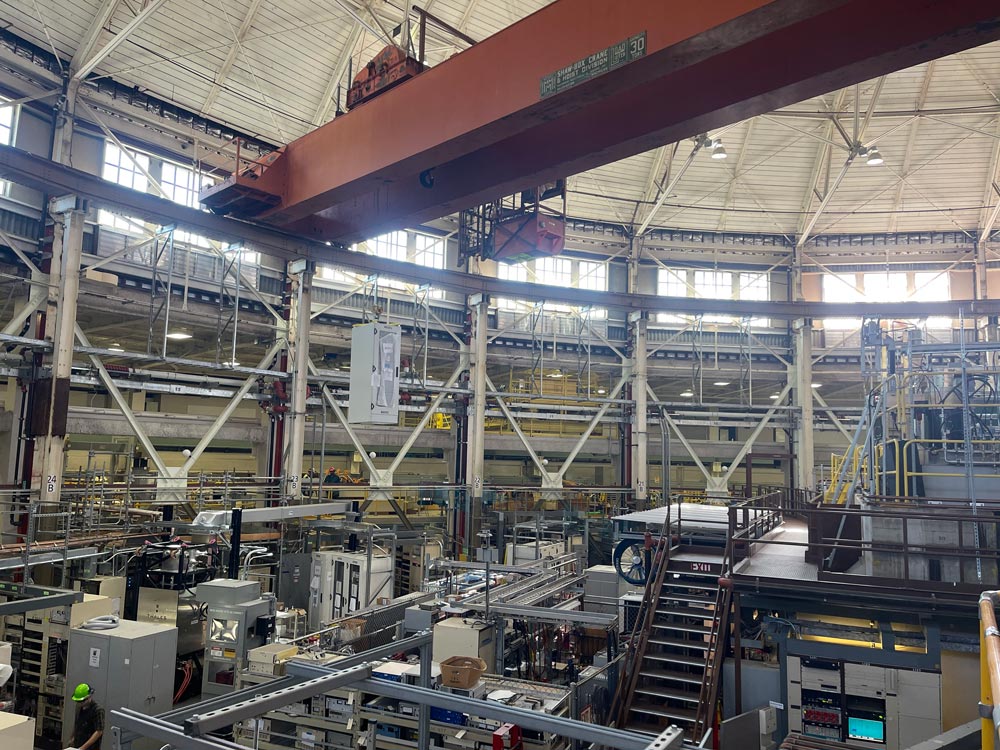
Moving racks – large, heavy containers that house delicate electronics – was a particular challenge until a special device was created by the Engineering Division to make this task easier. Originally, racks were lifted using long slings attached to four rings at the top corners of a container. This setup meant the racks, plus the rigging, were too tall to fit over obstacles in the ALS tunnel, like guardrails or stacked roof blocks.
“It could take an entire day just to move the rack around the tunnel roof to the correct laydown spot because the mech techs would have to constantly remove guardrails and go through a fall protection procedure,” says Adam Stewart, a mechanical engineer in the Manufacturing Engineering Department at Berkeley Lab. “Given that hundreds of new racks will ultimately be installed for ALS-U, this was not ideal.”
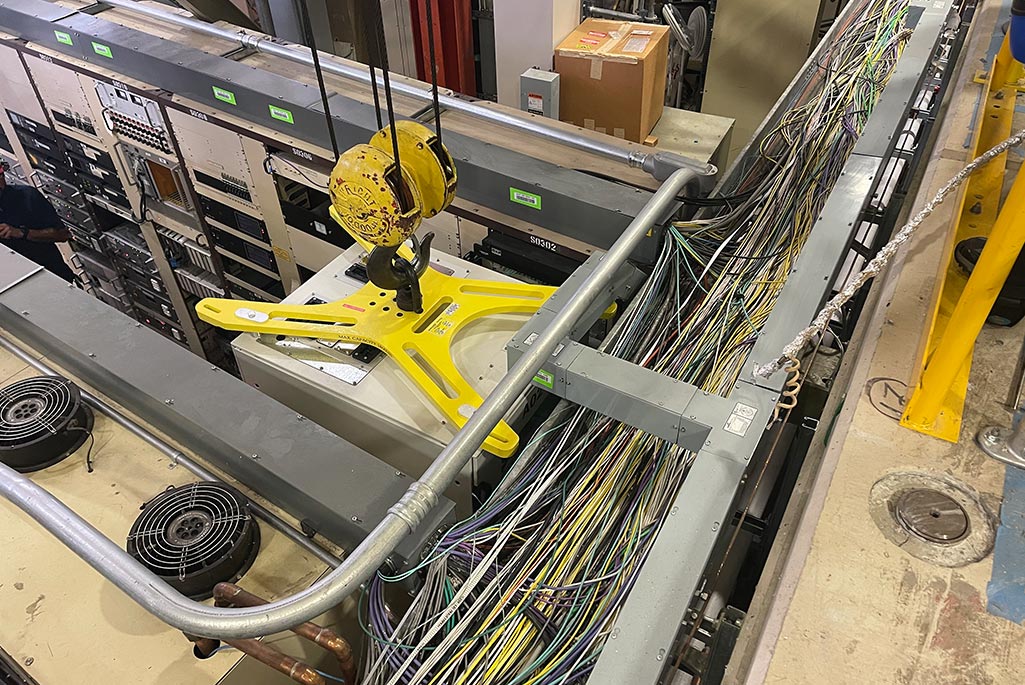
Seeing this issue, the engineering team sprang into action. Stewart designed a custom rack lift fixture, which is a rigid device that bolts directly to the top of the rack and has a very low profile. This allows racks to be lifted nearly 4.5 feet above the roof of the storage ring tunnel using the ALS’s annex crane, the crane that traverses the entirety of the storage ring. This provides enough clearance to easily move over guardrails and other obstructions. The rack lift fixture is also compatible with the ALS’s polar crane, which moves the rack to its final location in the “Pit,” the center region of the ALS that houses much of the electrical infrastructure for the facility.
A major engineering challenge when designing the lift fixture is that every rack can have a different center of gravity. For every lift, the crane has to attach in a spot that will keep each rack level – an important consideration due to the sensitive electronics housed inside. To mitigate this, the lift fixture has nine different attachment positions for the crane hook. The placement of the holes reflects calculations to accommodate different centers of gravity. Additional slots within the lift fixture allow for further fine-tuning to ensure the rack can remain level.
The rack lift fixture was fabricated in-house at Berkeley Lab Engineering’s state-of-the-art machine shop in Building 77. The piece is made of a specialized grade of high-strength steel.
“The lifting fixture started as a large rectangular sheet of high-strength steel that was loaded onto our waterjet cutting system, where an approximately 57,000 psi stream of water mixed with abrasive garnet was used to cut out the outside shape and interior slots of the steel sheet, turning it into a rough fixture blank,” explains William Evans, a mechanical engineering technician who worked on fabricating the piece. “Cutting time was approximately eight hours due to the size of the design and thickness of the steel.”
The part was then machined, then clear- and powder-coated with a durable paint fixture. This work was completed by Machinist Bun Pa Lim, along with other machinists in the Division.
The rack lift fixture has helped make work more efficient for crews installing racks in the ALS. It’s been so successful that a second device is currently being fabricated so that each of the ALS’s two cranes can have a dedicated fixture and the team doesn’t have to spend time transferring one device back and forth.
“From the removal & installation (R&I) team’s perspective, it’s been exciting to see the rack lift fixture evolve from real-time experience to design, fabrication, testing, and qualification so quickly,” says Kyle McCombs, ALS Mechanical Technology Group Lead and Mechanical Engineering Technical Superintendent in the Engineering Division. “The mechanical engineering and manufacturing teams, particularly with design support from Adam Stewart and all the effort from the Building 77 fabrication shop, made a big impact on bringing it to life on the job site!”

###
Made in Berkeley Lab is a series about the many innovative and groundbreaking items the Engineering Division makes on location, showcasing the highly skilled fabrication and manufacturing expertise at the Lab. From tiny robots and tight tolerances to mammoth detectors, powerful magnets, and new materials, it’s all made right here in Berkeley Lab.
